Political Currents by Ross Barkan

Political Currents by Ross Barkan

A Political Season Without the New York Times

Life without endorsements

Ross Barkan's avatar
Ross Barkan
Jun 23, 2026
∙ Paid

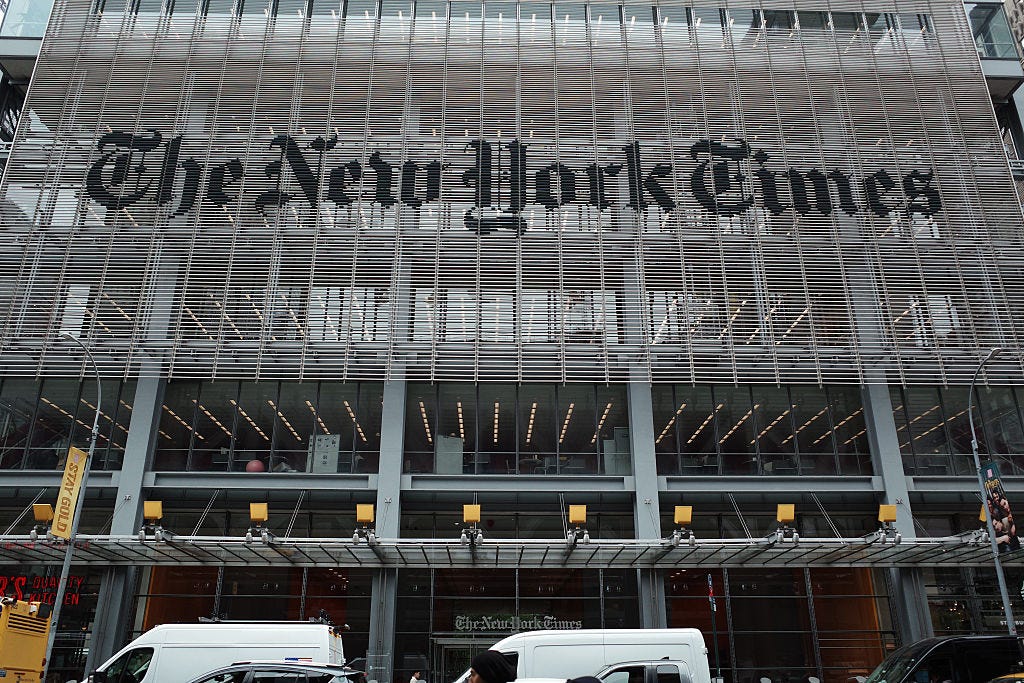
And so another high profile election season has passed in New York City without the New York Times editorial board endorsing in any of the major races. Few, truthfully, have noticed. Ever since the Times announced it was no longer endorsing in local races, breaking with a tradition that had lasted many decades, if not longer, politically attuned folk like me have wondered what it all might mean. There was a time, not very long ago, when the Times editorial board might tell you who they thought should win in a City Council race. Now you are lucky if they dispatch a reporter to write on that race at all. The decision to not endorse in local contests—the Times still wants to tell their readers who they like in the next presidential contest—seemed to signal that the Paper of Record was not going to prioritize the local. This is, despite the protestations of the Times itself, mostly true. Ever since they abandoned the standalone Metro section in the newspaper, granular coverage of the city has faded away. This is not a reflection on the talent of the City Hall, political, and local reporters the Times employs. They are top notch. It’s more about choices management has made as the newspaper, unlike almost any in America, grows it profits. You do not open the New York Times to find out, each day, what is happening in New York City. For that, your best bet is the right-wing New York Post, Gothamist, The City Reporter, Hell Gate, and other local outlets trying to fill the gaps.

Does it actually matter that the Times editorial board is not endorsing anyone in the clashes between Claire Valdez and Antonio Reynoso, Brad Lander and Dan Goldman, and Darializa Avila Chevalier and Adriano Espaillat? Here’s a dull answer: yes it does, and no it doesn’t. Allow me, first, to admit I’ve long believed the idea of a newspaper editorial board backing a candidate with an unsigned editorial is an outdated and befuddling practice. I blame no media organization that refuses to do it. The average reader struggles to distinguish between a conventional column and an editorial. Publishing any writing that’s unsigned dodges accountability. Editorial boards tend to embody a corporatized groupthink. I rarely, if ever, turn to them for any sort of political guidance. And an especially lousy editorial can make life difficult for reporters on staff. I know this firsthand: I quit the Jared Kushner-owned New York Observer after they endorsed Donald Trump in the 2016 Republican primary in New York. It’s fine, then, the Times is not telling us who they prefer in any of the aforementioned races or the battle for the 12th District in Manhattan, the most Times-obsessed seat in America. Why should we care, really? For leftists, the end of local endorsements is an underrated boon. There is little chance the Times editorial board, which savaged Zohran Mamdani a year ago, was going to endorse Valdez or Avila Chevalier. In fact, they might have not only backed Reynoso and Espaillat but delivered stinging criticisms of their leftist rivals, who both lack the experience the editorial board prefers. Andrew Cuomo was not technically endorsed last year—it was year one of the no-endorsement policy—but he was effectively greenlit by the board, which was still somewhat enamored with the scandalous years he spent in government.

Still, it’s worth explaining why it’s not a good development for local democracy that the Times is no longer dragging candidates in front of its editorial board. There are several ways, I believe, the voter is losing out.

And so another high profile election season has passed in New York City without the New York Times editorial board endorsing in any of the major races. Few, truthfully, have noticed. Ever since the Times announced it was no longer endorsing in local races, breaking with a tradition that had lasted many decades, if not longer, politically attuned folk like me have wondered what it all might mean. There was a time, not very long ago, when the Times editorial board might tell you who they thought should win in a City Council race. Now you are lucky if they dispatch a reporter to write on that race at all. The decision to not endorse in local contests—the Times still wants to tell their readers who they like in the next presidential contest—seemed to signal that the Paper of Record was not going to prioritize the local. This is, despite the protestations of the Times itself, mostly true. Ever since they abandoned the standalone Metro section in the newspaper, granular coverage of the city has faded away. This is not a reflection on the talent of the City Hall, political, and local reporters the Times employs. They are top notch. It’s more about choices management has made as the newspaper, unlike almost any in America, grows it profits. You do not open the New York Times to find out, each day, what is happening in New York City. For that, your best bet is the right-wing New York Post, Gothamist, The City Reporter, Hell Gate, and other local outlets trying to fill the gaps.

Does it actually matter that the Times editorial board is not endorsing anyone in the clashes between Claire Valdez and Antonio Reynoso, Brad Lander and Dan Goldman, and Darializa Avila Chevalier and Adriano Espaillat? Here’s a dull answer: yes it does, and no it doesn’t. Allow me, first, to admit I’ve long believed the idea of a newspaper editorial board backing a candidate with an unsigned editorial is an outdated and befuddling practice. I blame no media organization that refuses to do it. The average reader struggles to distinguish between a conventional column and an editorial. Publishing any writing that’s unsigned dodges accountability. Editorial boards tend to embody a corporatized groupthink. I rarely, if ever, turn to them for any sort of political guidance. And an especially lousy editorial can make life difficult for reporters on staff. I know this firsthand: I quit the Jared Kushner-owned New York Observer after they endorsed Donald Trump in the 2016 Republican primary in New York. It’s fine, then, the Times is not telling us who they prefer in any of the aforementioned races or the battle for the 12th District in Manhattan, the most Times-obsessed seat in America. Why should we care, really? For leftists, the end of local endorsements is an underrated boon. There is little chance the Times editorial board, which savaged Zohran Mamdani a year ago, was going to endorse Valdez or Avila Chevalier. In fact, they might have not only backed Reynoso and Espaillat but delivered stinging criticisms of their leftist rivals, who both lack the experience the editorial board prefers. Andrew Cuomo was not technically endorsed last year—it was year one of the no-endorsement policy—but he was effectively greenlit by the board, which was still somewhat enamored with the scandalous years he spent in government.

Still, it’s worth explaining why it’s not a good development for local democracy that the Times is no longer dragging candidates in front of its editorial board. There are several ways, I believe, the voter is losing out.

Allow me an aside on the New York Editorial Board, a collective of city reporters and editors who have taken it upon themselves to recreate the work that used to be performed by the Times’ editorial board. The NYEB is a Substack with a modest but attentive following, and they deserve serious credit for successfully interviewing most of the leading candidates running this year. The interviews are lengthy, very serious, and policy focused. If you’re an undecided voter, they’re especially helpful. Several NYEB interviews have made news already. One shined a light on Reynoso’s unusual housing arrangement, while another revealed Avila Chevalier still effectively doesn’t believe in conventional prisons. The NYEB doesn’t issue endorsements, which is for the best. They perform the most essential task: the interview. All transcripts are published in full. The NYEB deserves kudos, too, for convincing these candidates to sit down at all. In this social media age, more and more politicians are trying to do end-runs around journalists. Why subject yourself to difficult questions when you can cut a TikTok video and call it a day? The NYEB has the gravitas to convince these candidates to take time out of their day to face down a panel of experts.

Of course, the NYEB was less essential when the Times was doing this work. The Times does have the power to compel all candidates—including those who ducked the NYEB, like Jack Schlossberg—to show up at their offices. In the internet age, when full transcripts can easily be published, it’s especially disheartening that the Times is opting out of the endorsement hustle. Full New York Times interview transcripts in all of these races would have been quite useful. Adriano Espaillat did not speak to the NYEB but he very likely would have appeared in front of the Times. Grace Meng, another House incumbent, is facing a primary in Queens. The NYEB didn’t publish interviews with her or her opponent, Chuck Park, but a motivated Times editorial board could have, since Meng would probably not snub them. Both Meng and Espaillat could have been forced to answer tough questions over their close relationship with AIPAC and enduring military support for Israel.

The Times could simply perform the function of the NYEB and decide, like them, they won’t endorse. That might be the best of all worlds. The newspaper is powerful enough to conduct an interview series like this without the payoff of an endorsement. Imagine, right now, if on the home page of the Times, a voter could page through transcripts of conversations with every viable New York House candidate. This wouldn’t be all that hard for the Times to do. Transcribing a conversation is simple—AI, with a human assist to ensure the AI didn’t screw up, can do that job—and the interviewers themselves could be the reporters who are following the races most closely, along with select editors and editorial board members. Perhaps the Times will do this in the future. What the newspaper shouldn’t do is repeat their 2025 fiasco. Instead of conventional endorsements, the Times convened a discordant outside panel to make their own recommendations, which were then published in a confusing format. After that, the Times issued a passive aggressive editorial where no direct endorsement was made but one candidate was eviscerated (Mamdani) while another was uplifted (Cuomo). A straightforward Cuomo endorsement, at least, would have been more honest. A reader would know exactly where the newspaper stood.

This is all, as they say, inside baseball. Most voters aren’t thinking about the absence of the Times editorial board in these contests. There are enough other ways to get educated. Democracy will survive. But it would be nice if the Paper of Record decided, one day again, the local was deeply relevant to them.

© 2026 Ross Barkan · Privacy ∙ Terms ∙ Collection notice
Start your SubstackGet the app
Substack is the home for great culture