

My new novel, Colossus, is out now. It has been called “masterful, as thrillingly devious—and as brilliantly controlled—as Philip Roth’s The Counterlife.” Buy it today.
One morning, the phone in Tony Asher’s office rang. He was sure, at first, it was a prank. “Hello, Tony? This is Brian Wilson. I need to write an album for Capitol Records, and I don’t have anybody to write it with. I’m under a lot of pressure because we’re already three months behind and I was wondering if you wanted to work on some of the songs with me.” Asher, a twenty-six-year-old advertising copywriter, did not know Brian Wilson very well. It was a call he never expected to receive. But he had only one answer, because no one in 1966 could say no to Brian Wilson. “I’d love to do it,” Asher said, when he realized the person on the other line wasn’t a colleague down the hall trying to trick him. “Just tell me where and when.”
“Great,” Wilson replied. “Come out next Tuesday.”
Asher, the son of the silent film star Laura La Plante and film producer Irving Asher, only had the dimmest idea of what awaited him. There was no sense that he would soon be working on an epochal album, both making and bearing witness to history, and that he would be forever linked to one of the great pop auteurs of the twentieth century, a symbol as much as a man, the embodiment of far-reaching and volatile genius. Brian Wilson, at the beginning of 1966, was a very famous man—or, more accurately, his creative project was very famous. The Beach Boys had spent the last three years belting out hit after hit, including two chart-toppers, “Help Me, Rhonda” and “I Get Around.” Few rock acts could speak more to this fizzing era of postwar American exceptionalism; with their odes to surfing, hot rods, and summertime bliss, they were something of a synecdoche band in the popular imagination, standing in for all the promise of Southern California. And there is no way to understand the United States of America without California, the gleam and hush of the Pacific, the bleeding edge of the godly frontier. Brian, one of three Wilson brothers, had been born during World War II and inherited this particular form of manifest destiny, part and parcel of the Golden State’s youth bomb, a capitalist transcendentalist. The story of the Beach Boys has been told and retold, swallowed up in books and films and documentaries and endless reams of oral recollections, and all of it, for a writer attempting to apprehend the history, can be like scaling a mountain in a dream, the crags and cliffs forever shifting, the laws of gravity bending and breaking, nothing to do but let go and hope there’s rock beneath. Writing on Pet Sounds is no easier. Forever deemed the second greatest album of all-time—no matter how many times, in seeming anguish, Rolling Stone reshuffles its rankings, Pet Sounds can always clock in at number 2—it defies the English language, as all great music does. This is why music writing, as a genre, can be a muddle, and a lot of it reads like maudlin prep school poetry. I’m no better. I am here, like most Beach Boys emissaries, ex post facto, born far too late to have enjoyed anything approximating their peak. I did not even become the devotee I am until my thirties; there are no childhood memories of singing along to “Wouldn’t It Be Nice” in the backseat of the car, and my own adolescent angst never aligned with Brian’s. I fell in love with this music as a full-fledged adult, my sensitivities and neuroses dulled. When the Beach Boys reunited in 2012, the news meant nothing to me. Music, as Brian once said, is God’s voice, and there’s no telling when the holy spirit might whisper through you. For me, it was at the age of thirty-two, and I’ve been a convert since, buying up more than two dozen Beach Boys vinyl records and at least dozen books on the band. My brain is swollen with the trivia of their lives. It would be easier, in some sense, if I knew less. The gothic saga of the Beach Boys threatens to occlude the music that made them immortal.
On May 16th, exactly sixty years ago, Pet Sounds reached record stores. This will be the most understated and anticlimactic anniversary of the album because so many of the principals are dead. Brian died last June, which means there are no surviving Wilson brothers. A vast majority of the Wrecking Crew, minus the likes of Carol Kaye and Don Randi, are gone. Chuck Britz, the brilliant sound engineer, is long dead. Glen Campbell, who played on Pet Sounds and toured with the Beach Boys before vaulting off to country and pop rock superstardom, died in 2017. So many other voices that might have popped up during past anniversaries to opine on the record and swap war stories are no longer here. Jerry Cole, the session guitarist whose 12-string plugged directly into the console to play the iconic guitar intro in “Wouldn’t It Be Nice,” died in 2008. Hal Blaine, the legendary drummer who coined the term Wrecking Crew (the session musicians who played on Pet Sounds and most other major albums of that era did not have a nickname for themselves), died in 2019. A decade ago, Brian was still touring, and performed songs from Pet Sounds, somewhat distractedly and listlessly, for fans across America. In past decades, there were various anniversary editions and rereleases and box sets, ongoing celebrations to further canonize an album that was met, in the United States at least, with genuine befuddlement in 1966. For the sixtieth anniversary, there is a curious Beach Boys-themed Santa Monica 5k and a few more vinyl reissues, but nothing approaching what we might have seen in past decades. That is inevitable. As Paul Simon, a Brian Wilson admirer, once wrote, the leaves that are green turn to brown. There are surviving Beach Boys, and important ones, like Mike Love, Al Jardine, and Bruce Johnston. Asher, who just turned 87, still lives. They all made vital vocal contributions to Pet Sounds and, in Love’s case, a smidge of songwriting. But there’s a reasonable sense that 2026 might be it—who’s to know which band members and associates survive another decade, or who is left to remember that glorious and very strange time.
There are misnomers about the Beach Boys of 1966, or at least half-truths that became conflated with other realities, other quasi-myths. Brian Wilson did not write Pet Sounds in a sandbox in his living room—that was the next album, the aborted Smile. Pet Sounds was not the first time the Beach Boys featured music that had nothing to do with surfing, the beach, or the thrill of the drive-in. Pet Sounds, as much as it was a Brian solo effort, the product of a miraculous vision of a single twenty-three-year-old man, could not have existed without the rest of the Beach Boys. And for those most attuned to the currents of the age, Pet Sounds did not emerge from a vacuum. Like a vast emerald wave building on the horizon line, it was visible to those who knew where to look—and listen. In 1964 and 1965, Brian was, in his own way, getting ready for Pet Sounds. Traces of what’s to come can be heard in “Wendy” and “We’ll Run Away” and, most clearly, in the second half of The Beach Boys Today! As Al Jardine, Beach Boys guitarist and occasional lead singer, once said, Pet Sounds wasn’t so much music you could dance to as music you’d make love to; there are sonic textures of the album found in the shimmer of songs like “Please Let Me Wonder” and “In the Back of My Mind.” And then there’s “Let Him Run Wild” which, like “California Girls,” promises a higher aural realm, the vibraphone, horns, tremolo bass, and Brian’s piercing falsetto engineered for a different, and better, pop future. One of John Lennon’s favorite Beach Boys songs (“This is the greatest! Turn it up, turn it right up. It’s GOT to be a hit”) was “The Little Girl I Once Knew,” another classic single from 1965. Randi’s ringing organ, Kaye’s thumping bass, the great bouts of silent that frazzled disc jockeys—it would have been deemed a success by almost any other band, but it’s failure to crack the top 10 meant it was not going to make Pet Sounds.
Pet Sounds was composed, produced, and sung by Brian Wilson when he was at the peak of his creative powers—and when, arguably, he was most sane. Any discussion of Pet Sounds requires the context, where Brian and the boys were, how the album was able to emerge in the first place. In the mostly excellent biopic “Love and Mercy,” it’s implied Brian’s retreat from the stage was what made Pet Sounds possible—that he stopped touring to write his masterpiece. But again, that’s a half-truth, and neglects the reality of 1965. At the end of 1964, the Beach Boys had crisscrossed the nation and embarked on a global tour, cementing themselves as the greatest American rock rival to the Beatles. They kept a punishing touring and recording schedule—in 1964 alone, they’d release three albums, including the seminal All Summer Long—that was, for a naturally shy frontman like Brian, a great mental strain. He was also partially deaf in one ear, the result of a genetic defect or a beating from his domineering father Murry, depending on which story you’re told. The primitive rock concert sound systems were damaging to Brian’s hearing.
At the end of 1964, on a flight from Los Angeles to Houston for a concert, Brian had a panic attack, sobbing uncontrollably. He played the next show but told the boys, not long after, he was done touring. He wanted to stay back and focus on composing and producing. At first, the other band members did not take this well. Brian, who played bass on stage, was the unquestioned leader of the band, the oldest Wilson brother, the chief songwriter, and de facto producer of every one of their albums. What was a tour without Brian Wilson? But they quickly understood this was for the best. The newly-married Brian—in a panic, he had recently wed 16-year-old Marilyn Rovell—was clearly uncomfortable away from home, and his value, to the band, lay in the songs he could dream up and produce. He was not Elvis Presley; fans were not paying, necessarily, to see Brian Wilson on stage at the Hollywood Bowl or at a fairground in the Midwest. They were there for the Beach Boys. The surf rock machine would hum on, the boys continuing on the road, Brian heading back to California to unveil their next hits. The plan, for 1965, went swimmingly. “California Girls” would not have been possible without Brian’s retreat. Nor would have the wonders from The Beach Boys Today! Two years before the Beatles stopped touring and became a studio band, Brian had done it on his own, showing what possible.
It is important to understand that, before the Beach Boys burst on the scene in 1962, what Brian Wilson accomplished was unheard of—not just in the sounds he conjured, but in how he went about making them. The three Wilsons were born in the unfashionable Los Angeles suburb of Hawthrone to Murry, a fledgling songwriter and the owner of a machining company, and Audree, a homemaker whom Mike Love, her nephew, once insisted was the real musical talent in the marriage. Murry was physically and psychologically abusive; the Murry tales are legion, from taunts to beatings to one story, that may or may not have been true, of Brian being forced to defecate on a plate as a form of punishment for a prank he pulled. Murry was probably hardest on Dennis, the middle child, who was the most energetic and rebellious. Dennis, in his youth, was the least interested in music and the most willing to fight—and fuck. From his teen years onward, he was an inveterate womanizer and the embodiment of the California myth, what people believed the Beach Boys were. Chiseled and tan, he surfed regularly, and he convinced Brian, when they started the band, to write songs about the new surfing craze. Carl, the youngest Wilson (the boys were born in two-year intervals from 1942 to 1946), was the quietest, an introspective, doughy child who avoided, for the most part, Murry’s wrath. There are, as Brian once sang, heroes and villains, and Murry was both to the Beach Boys. Without Murry, the band would not have signed with Capitol Records. Dreaming of songwriting stardom that would never come for himself—Murry was interested in easy-listening schmaltz and had little hope of breaking through beyond a song recorded by the Lawrence Welk Orchestra—he pushed the boys incessantly, and, in his tender moments, nurtured Brian’s budding interest in music, buying him records and encouraging the harmonizing he undertook with his brothers. Belying his later image as a neurotic and bloated shut-in, young Brian was a strapping jock, an adept outfielder on local baseball teams and a backup quarterback on the varsity football team who might have been the starter if he cared enough. It was on that football team where he met an undersized but dogged fullback named Al Jardine; in a botched play that was, apparently, Brian’s fault, Al’s leg was broken. Mike, the first cousin of the Wilsons, lived nearby in a far wealthier neighborhood, and it was at family singalongs where the cousins found their chemistry and first mulled a future in music together.
In truth, nothing about the Beach Boys was inevitable. Hawthorne, tucked near LAX, was no crucible of Southern California glamour. The Wilsons were unremarkable, working-class, and Brian headed off to junior college after graduating in 1960. The fortunes of the Love family declined rapidly, and Mike, who had impregnated a high school girlfriend, found himself working at a gas station. Al went out of state to take up pre-dental studies. In 1961, they were barely a garage band when they recorded their first single, “Surfin’.” Brought out by a very small label called Candix, the song, to the surprise of the boys, was a regional hit. They were originally called the Pendletones, a pun on the Pendleton shirt that was popular with surfers, and were only renamed the Beach Boys at the last minute after the Surfers, the alternative choice of the label, was found to be taken by another band. Shortly after, a neighbor who took guitar lessons with Carl, David Marks, would join up and remain with the Beach Boys until 1963, when clashes with Murry forced his exit. From the beginning, the Beach Boys did not sound like the surf rock that was beginning to dominate the local airwaves, if they shamelessly were glomming onto a trend.
Surf music, at the time, was constituted hard-driving instrumentals, like the sort heard from Dick Dale, the King of the Surf Guitar. The Beach Boys reflected Brian’s obsession with jazzy vocal groups like the Four Freshman and the jazz and classical compositions of George Gershwin. They owed plenty, too, to early rock, to the point where Brian directly cribbed Chuck Berry for “Surfin’ U.S.A.” In 1963, Brian heard Phil Spector’s “Be My Baby” and the musical trajectory of his life would change forever. Whereas the mercurial Spector could be alternatingly admiring and dismissive of the young Beach Boy leader—he once derided “Good Vibrations” as an “edit” record—Brian worshipped Spector’s compositions, and sought to learn, as much as he could, from the magisterial Wall of Sound. Another influence was Burt Bacharach, hugely popular in his era if underrated now, and Brian quickly began experimenting with unusual arrangements and classical instruments, layering his recordings with a high, bright gloss that Spector could never quite achieve, making them stand out well beyond the 1960s. Even the best Spector productions sound very much of their time, caged in 1964 or 1965, whereas Brian’s retain, sixty years on, an inarguable brightness and vigor.
The Beach Boys were the first major rock act to have a band member produce the records. Before Brian walked into the studio and seized control of his albums from the Capitol heavyweights, record labels exerted enormous control over recordings. Performers were often not writing their own material. The Beach Boys’ first album, Surfin’ Safari, was not billed as a Brian Wilson production. Neither was Surfin’ USA. This was because Capitol Records still operated by the standards 1950s, crediting production to their young staffer, Nick Venet. Venet helped sign the Beach Boys but he was not writing or producing the songs. The projection credit would be rectified on Surfer Girl, which jumped to 13 on the charts. It was the first of many albums that gave Brian the sole producer credit. One early reality of the Beach Boys, despite their peerless harmonies, was that they were deceptively weird, a superstar musical act melding and violating old traditions. They pulled off complex, a cappella glee-cub arrangements with sophisticated chords and modulations. They brought jazz harmony to surf. They smashed together Chuck Berry, the Ventures, and Frankie Lymon and the Teenagers, Brian’s compositions outstripping whatever rock had previously brought to bear.
It was Carl who followed the Beatles most closely; Brian, also a fan, took an interest in their artistry and dominance. Beatlemania ensured the Beach Boys were no longer the preeminent rock group in the United States. It didn’t help that Capitol, the label the Beach Boys belonged to and increasingly resented, was the Beatles’ distributor in the U.S., and that their band names were so close alphabetically. Any record store, naturally, would throw the bands together. If the other boys wanted to keep producing hits to keep pace with the Beatles, Brian wanted something far more—to create art that would both surpass the Fab Four and transcend, in ways unimaginable, what they had all been doing to that point in time. If the Beatles had the marketing savvy to overcome Capitol’s dreadful instincts—butchered track listings on American releases, album titles like The Beatles’ Second Album and Beatles ‘65—the Beach Boys never could properly position themselves, from a public relations perspective, for the era of sophisticate rock. The public only saw them as the barely pubescent men in striped shirts singing about summer days and summer nights. Even the arrival of Pet Sounds wouldn’t chase that image away, the Beach Boys as rubes of the sepia-toned age, and Capitol had no incentive to market them differently, anyway. Surf and sun sold records.
At the dawn of 1966, Brian Wilson found himself at a crossroads. He wouldn’t turn twenty-four until June, but he was already an industry veteran under immense pressure. Rock and pop acts were largely ephemeral, and record labels were quick to ditch anyone who couldn’t demonstrate an obvious upward trajectory. In 1964, he had fired Murry as the manager of the band, but his father still dominated the lives of his sons. If Brian produced a hit, the executives at Capitol—and Murry—might each simply bark for the next one. The Beatles had more hits anyway, and they weren’t slowing down. It helped, too, that they were a band of at least two pop geniuses, along with a renowned producer in George Martin who could translate their ambitions in the studio. Brian was the George Martin of the Beach Boys, as well as the John and Paul. This isn’t to say the other band members weren’t talented, or were irrelevant to the tremendous success of the band. Carl, the youngest brother, had emerged as the leader of the touring band, and it would be his vocals ringing out on seminal records like “God Only Knows” and “Good Vibrations.” It was Carl, too, taking the lead on the Beach Boys’ most Beatlesque song, the underrated “Girl Don’t Tell Me.” In 1966, Dennis was the dashing drummer, making all the girls scream when he walked on stage. Dennis loved the rock star life but was somewhat indifferent, then, to recording, happy to jet off with his women or his automobiles as session drummers filled in for the band’s newer albums. In time, Dennis’ creativity would flower, and he would write some of the most soulful, yearning, and idiosyncratic songs in the Beach Boys catalog. Improbably—for anyone living in the 1960s, at least—he would become the first Wilson brother to release a solo album.
But Dennis was not yet a songwriter, Carl was only nineteen, and Mike, while pivotal to the band’s very existence and the lyricist for many of the most durable hits, was not who Brian wanted to turn to. At least, not for the unnamed album that was burbling up inside of him. Though he was plenty capable of writing lyrics, Brian had a certain shyness and sensitivity around the language of songs; he never quite believed in himself enough to commit words to the sensations and melodies he could imagine at will—the “feels” he’d get from playing his piano—during those fruitful early years. From the start, he sought out lyrical collaborators. There was cousin Mike, who was present most. But he wrote “In My Room” with Gary Usher, a neighbor who he might have formed a more long-lasting songwriting partnership with if not for Murry’s meddling. To write some of his car songs, Brian teamed up with Roger Christian, a local DJ who was heard on the air explaining the intricacies of the hit “409.” From that partnership came “Little Deuce Coupe” and “Don’t Worry Baby.” Brian was fickle too, and he was always ready to cycle in a new voice when a fresh creative impulse seized him. By 1965, he was smoking marijuana and experimenting with LSD, which was in its earlier, more unadulterated form. It wouldn’t be inaccurate to describe Brian as an acid casualty; the heavy acid use likely tipped a young man prone to mental illness into deeper psychosis. But that lay in the near future: the early 1966 version of Brian Wilson was plenty coherent, sociable enough, and a songwriting factory unto himself.
Pet Sounds was a response to Rubber Soul—not so much in sound as in form. The album era was just dawning, and Brian was deeply impressed that the new Beatles release seemed complete to him, devoid of the filler that made up so many rock albums of the period. Until the 1960s, albums were an afterthought, with singles dominating the market. A record label did not care about anything approaching a unified artistic statement. The story goes that Brian, upon hearing Rubber Soul, charged into the kitchen and told his new wife, Marilyn, that he would make “the greatest rock and roll album ever made.” For anyone else, this would be a sign of mania. Brian meant every word.
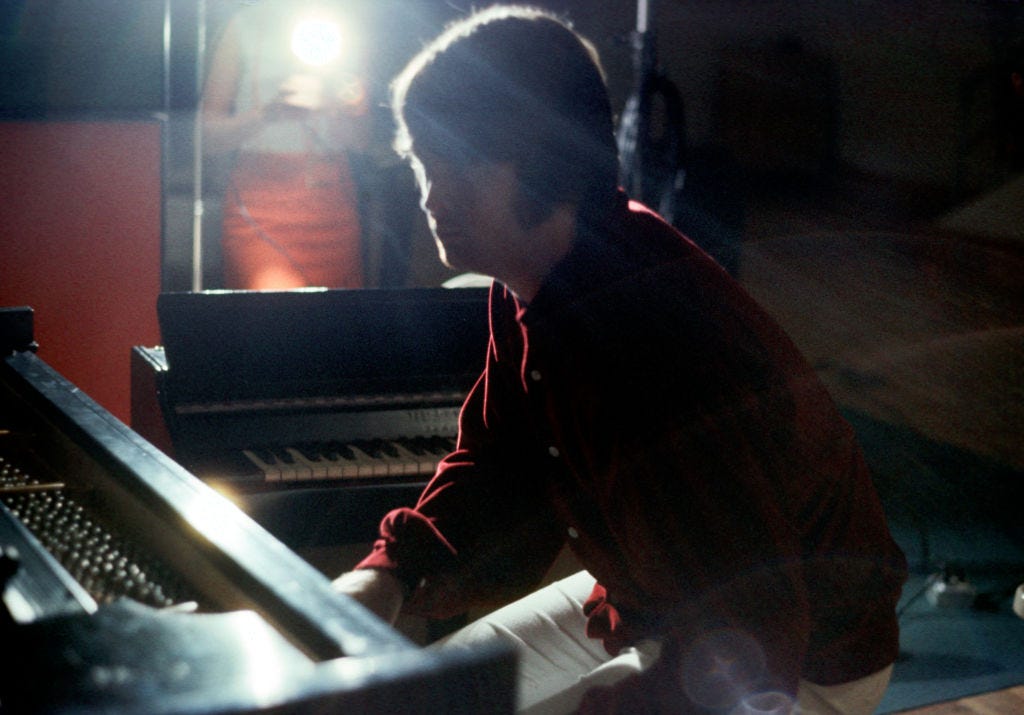
Why was Tony Asher his principal lyrical collaborator for Pet Sounds? As Chuck Granta writes in his outstanding account of the making of the album, Asher held appeal because he was such an outsider in Brian’s world. He was free of the band’s fraught internal dynamics, and represented the clean break Brian was seeking for his new work. A handsome Hollywood scion with a successful career of his own, Asher had written jingles for Mattel, Barbie, and Chatty Cathy dolls. The men had first met in 1965, at United Western Recorders, but Asher did not imagine he’d be receiving an actual phone call from Brian to write an album. One advantage Asher had over Mike Love was that he played piano—if the musical ideas for Pet Sounds would be Brian’s, Asher could sit with him, at the piano, and speak in the intimate language of the keys. They would meet at Brian’s house in Beverly Hills to write. This was not the Bellagio Road manse of legend, where Brian would build a home recording studio. He was not yet pressing his feet into the sandbox, smoking hash in his Arabian tent, and hiding out, like a paranoiac, in his swimming pool. The Laurel Way home was far more modest, a California-style ranch house that did not seem like it belonged to a rock superstar. There were a few large sofas, a fireplace, and a piano that dominated the living room. Asher’s employers were happy to give him a sabbatical to co-write the album—this was Brian Wilson of the Beach Boys, after all—and he would arrive at the house in the morning, waiting for the pop auteur to rustle himself out of bed. Brian sat at the piano bench, Asher standing next to him, and made up melodies, singing without words. Asher might offer small comments on the melodies, but they were wholly Brian’s. It would be up to the copywriter to imagine words, both at Brian’s side and when he went home at night.
If Brian forgot a chord change, Asher would remind him of it, and there was a give-and-take that Asher found surprising, given Brian’s stature in the field. He was open to input, to tweaks and adjustments. He was guileless, and largely devoid of ego. Asher’s recollections of his collaborations with Brian are far more generous in Granata’s account, published in 2003, than in Steven Gaine’s best-selling and quasi-notorious Heroes & Villains, a gossipy Beach Boys biography that appeared in 1986. Speaking as a much younger man to Gaines, Asher called Brian the “single most irresponsible person” he had ever met. Uncashed royalty checks totaling over $100,000 were splayed around the house. Brian could alternate between uncontrollable fits of laughter and crying jags, and he would sometimes halt songwriting work to watch “Flipper” on television, tearing up over tender moments. He anguished, openly, about how he was sexually attracted to his wife’s sister.
Brian, though, was no fool. The term “concept album” did not exist, but Pet Sounds, still untitled, would have a unity of theme and spirit. It would sound like almost nothing that came before it; this novelty, in fact, would help to doom it in the short term. In the cultural furnace of 1966, Pet Sounds did not exactly make sense. It was a performance of angst and melancholia, the beauty and sadness and fragility of young love, a glittering representation of interiority approximating the power of a modernist novel. Pet Sounds did not make any obvious gestures to the Sixties zeitgeist. It did not have a politics. It did not rock. Most of these songs were not getting blasted out of car windows or ringing out at anti-war rallies. The burgeoning hippie movement wouldn’t know what to make of them. Jefferson Airplane, Joplin, and Hendrix were more their speed. Or, for the sensitive and cerebral types, there was Simon & Garfunkel and Bob Dylan, who spoke to the English majors haunting the coffee houses. An album called Pet Sounds—what a peculiar appellation!—with that photograph of the boys feeding animals at the San Diego Zoo was bound to confound record buyers. An album called Pet Sounds that was, loosely, about the rise and fall of an adolescent romantic relationship would only befuddle them more. Brian Wilson and Tony Asher didn’t necessarily premeditate the album’s sequencing or imagine there would be this sort of emotional arc. When they wrote, there wasn’t a single concept—it was two young men who came together to write about love, the romantic situations they had known, the longing and the heartbreak. The music itself would be startlingly complex, but the lyrics were crisp, unpretentious, and legible to any young person who had ever loved another—or wanted, very badly, to be loved.
The procession went like this: hammering out melodies and lyrics over Brian’s piano, then the instrumental recordings with a wide array of seasoned session musicians, and finally vocals from Brian and the rest of the band, who were touring Japan at the beginning of 1966 and would return to find the album nearly done, waiting for them to sing over instrumental tracks Brian and the Wrecking Crew had already laid down. Pet Sounds can, to an extent, be understood as a solo album, the creative effort that least involved the rest of the Beach Boys. This spurred tension that would take years to dissipate, and would only resolve itself when Brian began to retreat, ceding more and more songwriting and production to the rest of the band. It would be wrong to say Pet Sounds could have happened entirely without the rest of the Beach Boys, because they were the brand—they, in concert with Brian, made his ambitions possible. Capitol Records would not allow in excess of $70,000 to be spent on the first Brian Wilson solo album. Only for the Beach Boys could there be such an indulgence. And it’s worth noting that Brian’s instincts, impeccable most of the time, could fail him during the making of the album. While working with Asher, he began playing an intricate song about the “vibrations” one might feel from a girl, building off of an anecdote his mother had relayed to him about dogs sensing these “vibrations” from humans. By the early months of 1966, Brian had grown serious about this strange new psychedelic symphony, and once the rest of the band heard it, they begged for its inclusion on Pet Sounds. The album, they fretted, lacked a clear hit, and here was one. But Brian refused. He wanted to tinker with the song further and further, shuttling among studios to realize his avant-pop dreams. What could the rest of the boys do but wait? In October, nearly a half year after Pet Sounds was released, “Good Vibrations” hit the airwaves and because the Beach Boys’ third number one hit. All was well, except the other band members couldn’t help but wonder what Pet Sounds might have been with “Good Vibrations.” Thematically, perhaps, it didn’t quite match the melancholia of the record, but it would have undoubtedly improved sales. Imagine, for a moment, the effervescence of “Wouldn’t It Be Nice”—the smashing opener—followed by “Good Vibrations” instead of “You Still Believe in Me”, a majestic but slower number that stalls some of the album’s early momentum. What a rush that would have been.
The beating heart of Pet Sounds was Brian Wilson in the studio, commanding the greatest session musicians in the world. It was here, like a fresh-faced Californian Bach, where he shone the most and burnished his well-deserved legend. For these guitarists, bassists, cellists, violinists, clarinetists, flutists, pianists and drummers who had played, throughout the 1950s and 1960s, on the most successful pop and rock records anywhere, working with the twenty-three-year-old would be an experience like none other, one they would be compelled to talk about for the rest of their lives. Pet Sounds was not just one of the first albums where one individual was responsible for much of the music, from writing to arranging to producing and even performing. It was, arguably, the very first time someone of Brian’s stature as an artist was in control of all aspects of a record. The session musicians could sit for many hours, late into the night, as Brian dictated every part, every note. Unlike the record, film, and TV recording sessions the musicians were used to, the gigs with Brian were not scripted; they followed, fully, the movement of his mind. The music paper before them was blank. Brian would hum and sing his ideas, and the musicians would hurriedly transcribe them into chord symbols on their charts. They would begin playing, only to stop—Brian might hear something in the orchestration, almost ineffable, that he did not like. And they’d start again. Twenty-two starts and stops before, after much chiding and instructing and toying, Brian had a take he liked. Take one, begun twenty-two times. The French horn, the harpsichord, basses, a seraphic flow of sound, and here is, finally, the “God Only Knows” that Brian had heard in his head. He was satisfied. Brian, with his one good ear, leaned in absurdly close to the monitor. He strained, on the playback, to hear the sounds other people could not hear. The musicians who had cut records with Elvis and Sinatra and virtually every other legend of the last two decades could sigh with some relief. Brian liked what he heard.
He was an intuitive producer, a warm-hearted perfectionist. Like Spector, his idol, he recorded vocal and music tracks separately. He shuttled among three different studios to achieve the sound he needed. Each studio could have its own character, since there were not yet standard console manufacturers. Spector’s low-ceilinged Gold Star was where the Wall of Sound was birthed. This was the mono wall, the blasting panorama, what entranced Brian. But Pet Sounds would swim past Spector’s horizon line. It was a supple, sublime record, like a shimmering starscape; it did not assault the senses, and it did not thunder. Recording originally in mono, not stereo, Brian was still able to extract the most from the 1960s multitrack technology by recording on different channels, layering the instrumental and vocal components he had captured independently. There was an ethereal quality to the mono, with certain sounds, far more perceptible on stereo, barely heard in the original mix, like the French horn at the end of “God Only Knows” that is a mere whisper. Working with sound engineer Chuck Britz, who was something like a surrogate father, Brian could tease out every sound he wanted, even at times when it seemed like he was asking for a certain part the professional musicians couldn’t imagine. In many ways, Brian worked like a jazz composer, improvising riffs and chord changes on the spot, hunting out ever stranger combinations and movements. He could barely write music: the notes would be on the wrong sides of the stems, sharps and flats rendered incorrectly. But it was his music, and he could, to the shock of the veterans in the studio, keep it all in his head, no matter how kaleidoscopic it became. They played exactly what Brian wanted. The peculiar keys, the harmonic modulations, and the polytonality were all out of place in any pop rock record of the era, and this could be its own thrill. Many of the songs on Pet Sounds, which was still untitled when Brian went into the studio, were punctuated by irregular breaks in tempo, sudden shifts, and keys that were highly unusual, the F sharp for “That’s Not Me.”
Brian was giddy to throw precedent out the window. The instruments and sounds themselves were, for a rock record, idiosyncratic, if not subversive. “Sloop John B,” the lone cover, was a blend of rock and marching band instrumentation, with flutes, glockenspiel, and baritone sax meeting with bass, guitar, and drums. Exotic percussion, guiros, steel guitars, and bass flutes were melded with traditional instruments in this new pop orchestra. A detuned guitar could conjure the sound of a calliope. A bicycle bell, bicycle horn, and finger cymbals were layered for spritely juvenilia, while a bass harmonica was the ominous undercurrent to “I Know There’s an Answer,” Brian’s meditation on LSD—his struggle with ego death—that cousin Mike originally resisted. (Al was tapped to sing lead.) For “I Wasn’t Made for These Times,” haunting Electro-Theremin made its debut, and Brian would soon make the instrument itself famous when he featured it on “Good Vibrations.” Pet Sounds’ plaintive closer, “Caroline, No,” is a percussive marvel, water jug, tambourine, and muted bells backing the enchanting flutes and saxophones, the instruments doubled and playing one octave apart, Brian’s tearful vocal, sped up slightly, quavering with the loss of romantic innocence. This would be the first track ever released under Brian’s own name, reaching the airwaves two months before Pet Sounds.
Anyone who plunges deep enough into the lush mysticism and light eroticism of Pet Sounds will find one track they privilege over another. This might change with time. It is fair to call “God Only Knows” the premier pop record of the twentieth century. But there might be times you prefer “I’m Waiting for the Day” or “That’s Not Me” or “I Just Wasn’t Made for These Times.” You might marinate in the two instrumental breaks, “Pet Sounds” or “Let’s Go Away for a While.” The track that I found, with time, I lost myself inside of the most was “Don’t Talk (Put Your Head on My Shoulder).” One of the more overlooked songs on the album, it features, like “Caroline, No,” only Brian on vocals. I do not prefer it because the other band members are absent—their voices are, on most of the tracks, essential—but it works with Brian’s vaporous vocal lead, backed by a string section that, unwittingly, harkens back to Brahms. It might have been my experiments with psilocybin that unlocked the power of the song for me—I am not sure, and I can only speak to what I noticed before and what I noticed after—or the simple act of repetitive listening, an ear tuning to a frequency, the ineffable nature of a revelation. Four violins, one viola, and a cello layer the melody, Brian singing of the sensation of a lover in your grasp, that moment of trepidation, the catch in your throat: “Don’t talk, take my hand and let me hear your heart beat.” And then: “Take my hand and listen to my heart beat—listen, listen, listen.” Asher’s lyrics exquisitely match the sound, which is still difficult to fully render, which begs, like a heartbeat, to be listened to with every atom left in you. There is music sing to, and then there is music to melt to, melt within, empyreal music, music of the body and music beyond the body. Paradise, in just under three minutes.
The vocals of Pet Sounds were constructed no less meticulously than the instrumentation. Brian’s bandmates were, at times, unsure about his new musical direction, and Mike openly questioned how commercial this all might be. At first, said Al, they were “dismayed” because they had been on the road, touring, and returned to find all of this new material, these instrumental beds they did not quite understand. But once they began to comprehend what Brian was reaching towards—how revolutionary this all might be—they took much more enthusiastically to the sessions. They’d meet in the studio in a football-style huddle, Brian coaching them around a piano. Bruce Johnston, the newest Beach Boy, described him as a good-humored General Patton, explicit and exacting. The vocal sessions didn’t last as long as the instrumentals, and the boys could arrive in the afternoon and be done in the evening, when there’d be time have dinner or go to a club. Luau was a hot spot on Rodeo Drive, where the Beach Boys, usually sans Brian, could be found over Polynesian drinks, comely girls always nearby. But it was nothing but work within the studio; Brian pushed his bandmates just as hard as he would the session musicians, forcing already great vocalists to heights they hadn’t known before. One passage of “Wouldn’t Be Nice” might require close to thirty vocal takes, some of them indistinguishable to even the most seasoned of singers. Brian, though, knew what he wanted, a melding that was almost cosmic, beyond the range of conventional hearing. What continued to amaze his bandmates was how he could keep so many different vocal parts in his head. A session might begin with him “dealing” out the parts to a song, singing the melody, the high falsetto, showing Mike, Al, Carl, Dennis, and Bruce what it was he required, treating the vocal tone of each band member as an instrument. Mike’s bass, his doo-wop inflections, added weight to the blend, and he’d contribute his own ideas for lyrics and vocal arrangements. Decades letter, he’d successfully sue for a songwriting credit on “Wouldn’t It Be Nice.”
The rest of the band had every reason to believe in Brian because they had found such fantastic success when following his lead. Trepidation gave way to excitement. The reverberant glow of the vocals was made possible by Brian’s penchant for doubling them, recording a voice and then superimposing another on top of it. The sound was bigger, brighter, escaping the gravity of the present day. Mike would have his own microphone, because his bass parts were mostly inaudible without amplification, while the other boys would often sing together on a different microphone. Part of Brian’s power was that he could, if he wanted, sing every part well, but he understood it was the multipart, weaving harmonies that, for most of the songs, lent them their resonance. “God Only Knows” was the vocal summit of the album, a performance one could transmit into outer space as representative of the heights of human civilization. Only three Beach Boys actually sing on it: Brian, Carl, and Bruce. Celestial, angelic, godly—all adjectives apply, as trite as they might sound. The song, already somewhat taboo because anything featuring “God” in the title was exceedingly rare on the radio, was deceptively sophisticated, with counterpoint and a weak tonal center, the vocal parts numerous. Brian, originally, chose to sing lead, but decided the part worked best for his brother Carl, who sounded very much like him. He had planned, originally, for a nonvocal bridge, overdubbing a saxophone solo. Dissatisfied with the mix, he instead created the three-part vocal interlude, superimposed over violin, cello, bass, tambourine, and wood blocks. Each vocal part conveyed a sense of motion, opposing rhythmic elements merging in stunning fashion to provide a release in the tension, the jazz-inflected “ba’s” bleeding into the sigh, which was unheard of in pop. The round-style ending tagged onto the song’s final verse only featured two voices, though it sounds like far more. Together, Brian and Bruce overdubbed the successive rounds, part by part. Carl had finished singing the lead and the center harmony parts, but he was tired. Brian sent him home, and the boys found they had extra time in the studio and open tracks. Brian took the top and bottom parts, and Bruce hung in the middle. Together they went. By the time the vocals for Pet Sounds were finished, the band members had lost all hesitation or even cynicism about the effort. They understood the sublimity. They knew, with Brian, they had done something great.
Pet Sounds did have its imperfections. The original mono mix was sloppier than Brian probably should have allowed. Distant talking can be heard on “Here Today” and the volume suddenly spikes on “Wouldn’t It Be Nice” during Mike’s vocal entry on the bridge. The author Chuck Granta speculates that these technical imperfections matter less to Brian than the “feel” of the album that he had produced. On that front, his high expectations were met, so the final mix was of less interest. Meanwhile, at the behest of Capitol Records, “Sloop John B” was added to the album, and it never quite squares up thematically with the other tracks, despite its inherent beauty. The executives feared Pet Sounds didn’t have a breakout hit, and they correctly guessed “Sloop John B” was going to climb within the top five. (Credit goes to Al Jardine for having the idea to record the song at all, since he was the folkie of the group.) Though iconic now, the album art, and even its name, do not quite suggest what’s on the record and even underplay the ambitions of the actual music. This was something the Beatles, who paid meticulous attention to album presentation, noticed. How the name of Pet Sounds came to be is still debated. Brian once credited Carl with naming the record, while Mike claimed he had the idea. The end of “Caroline, No,” the last sounds heard of the album, are Brian’s dog barking and a passing train. During the writing of the album, there was no indication Brian was going to use the title “Pet Sounds”—in retrospect, it seems like an afterthought. Tony Asher’s original reaction to the album title was that it trivialized Brian’s songwriting, though he warmed to it as the years passed.
On May 16th, 1966, the world would get to judge Brian Wilson’s masterwork.
There were warning signs, stateside at least, that Pet Sounds was not going to reach the lofty commercial heights that the Beach Boys, over the last three years, had almost treated as their birthright.
Capitol Records was not enthused about the album. The sound and style confused them. Where were the surfing songs? The odes to summertime bliss and cute girls? Why were the tracks so somber? Some executives pondered whether they should reject it altogether. Nick Venet, who had production credits on the first two Beach Boy albums, believed that Brian was “screwing up” and “no longer looking to make records, he was looking for attention from the business” and attempting to “torment his father.” Capitol decided to accept Pet Sounds, but the marketing team would struggle with how to position it. They were used to promoting tracks like “Help Me, Rhonda” and “Barbara Ann,” and could not relate to what was on the record. While the Beatles were permitted their aesthetic pivot, accepted as sonic pioneers, the Beach Boys were meant to remain as they were, frozen in the amber of 1963-1965. This ruminative, cerebral turn was not especially welcome. Upon release, Pet Sounds sold around 200,000 copies, an impressive sum for almost any band in the world. But this was the Beach Boys, still the most successful of all the American rock acts, and 200,000 was a lower number than prior releases. On the Billboard charts, Pet Sounds never climbed higher than number 10—new Beach Boys albums typically reached the top 5, and a live album had been number 1 less than two years prior—and failed, domestically, to make its mark with the record-buying public. Beyond the Beatles, Americans were buying up Herb Alpert records, Herman’s Hermits, the Rolling Stones, and the Mamas & the Papas. The Grammy’s ignored Pet Sounds entirely. American critics were, at best, polarized, with some celebrating the album as a masterstroke while other questioned the whole premise and wondered where the real Beach Boys had gone. To head off a downturn, Capitol quickly rushed out a Beach Boys compilation record that, to the quiet humiliation of Brian, promptly outsold Pet Sounds. Brian, having measured his self-worth by chart performances, despaired. “God Only Knows” barely reached the top 40 as a single. “Wouldn’t It Be Nice” rose to number 8, but this was no salve.
The reception to Pet Sounds was dramatically different in Europe. If Brian couldn’t quite take heart in it, the other boys could because they were the ones hitting the road, excited still to find, as their sales declined in the U.S., crowds in London and Paris and Amsterdam were still desperate to hear their music. Wisely, the Beach Boys hired Derek Taylor, the Beatles’ publicist, to promote Pet Sounds, and he enlisted Kim Fowley, the record producer who would go on to manage the Runaways, to drum up publicity in England. Bruce Johnston, the most socially adroit of the Beach Boys, traveled to London to promote Pet Sounds, playing it for the music press there and ensuring the most important audience of all got their exclusive listen. Keith Moon, an enthusiastic Beach Boys fan, helped to bring John and Paul to the London hotel where Bruce was staying so they could hear, at last, the next progression of pop music.
Paul asked the hotel staff to bring a piano into the suite, and one materialized. Then, the needle dropped. The two Beatles silently played canasta, listening to the record from start to finish. Once it was done, they leapt up to the piano and began playing several chords. After a few minutes, they left. Soon, they’d commence work on Revolver, Pet Sounds swimming through them. They were properly awed. Unlike the American media, the British critics heaped praise on the album, and followed Derek Taylor’s lead in referring to Brian, for the first time, as a “genius.” The plan by Taylor was to elevate Brian to the realm of Dylan and the Beatles as a rock maestro. And Brian was—there was no deception there, no fluffing of the record. If anything, when it came to wielding the studio as an instrument, Brian Wilson had superseded all of his contemporaries. He had found the new sound, at last. At the end of 1966, the Beach Boys were officially—for a brief moment at least—more popular than the Beatles in England, topping a New Musical Express readers’ poll. “We haven’t been doing much and it was run just at a time when the Beach Boys had something good out,” Ringo Starr said. “We’re all four fans of the Beach Boys. Maybe we voted for them.”
When “Good Vibrations” shot to number 1 several months after the release of Pet Sounds, it should have been Brian’s valedictory moment, proof that a proto-psychedelic pocket symphony of titanic complexity could become the best-selling Beach Boys single of all-time. And it was—albeit, for only a few months, as psychic clouds gathered. Brian had begun work on Smile, his “teenage symphony to God,” which was intended as the spiritual successor to Pet Sounds. Here would be an album of even more sparkling ambition. This time, instead of Tony Asher, Brian teamed up with Van Dyke Parks, a young songwriter and producer who was almost as precocious as he was. They wanted Smile to be the final rejoinder to the British Invasion, proof that the American idiom of pop was the grandest tradition of all, a tradition that they could, through songs like “Surf’s Up” and “Heroes and Villains,” reinvent for the second half of the 1960s. Leonard Bernstein believed as much, featuring Brian performing a snippet of the former, left unreleased until the early 1970s, for a documentary on the young innovators of pop. The trouble was Brian: his mental state was deteriorating, the nascent psychosis beginning to manifest itself more plainly as he consumed copious amounts of marijuana, hash, and acid. He believed the “fire suite” he recorded had caused actual fires in Los Angeles. He thought a painting a close associate had made of him had, somehow, imprisoned his soul. He believed a film he was watching contained coded messages from Phil Spector. Brian’s perfectionism mutated further; the band members and session musicians struggled with hours and hours of takes that didn’t seem to further the music at all. Smile’s release date was delayed, and delayed again. Eventually, Parks walked away. Mike Love was not overly fond of Smile, and he’s been blamed in some accounts for opposing the album enough to hasten its dissolution. But this is a simplistic explanation, and doesn’t account for Brian’s instability.
It’s a misnomer, usually among people who don’t create, that volatility and erraticism are prerequisites to high art, even genius. A genius, naturally, can fall into instability, but in the moment of creation he or she is most clear-eyed, most functionable. The Great Gatsby was published before alcohol addiction sapped F. Scott Fitzgerald of his vitality. Sylvia Plath’s poetry appeared when depression wasn’t immobilizing her. Smile became the lost album of legend, the Pet Sounds successor that would never, until the twenty-first century, see the light of day, when an elderly Brian Wilson, with the assistance of younger musicians who toured with him, reconstituted it as Brian Wilson Presents Smile. Once it became clear Brian was not going to finish Smile, the band raced, in 1967, to complete Smiley Smile, a pared-down, whispery record that would prove to be low-fi pioneer but only polarize their fan base even more.
The late 1960s were not kind to the Beach Boys. The age of Aquarius had little use for surf rock, and it didn’t matter that the boys didn’t play that kind of music anymore. An image clung: white bread, square, harmonies that were safe for your uncle. With Pet Sounds and the fragments of Smile, the Beach Boys had shown themselves as the heralds of psychedelia, sonic prophets of neo-Americana, but little of that registered with many of the young rock critics and the broader record-buying public. In 1967, the center of gravity shifted from Los Angeles to San Francisco, and suddenly the kids wanted harder-edged, bluesy rock or any music infused, even superficially, with the politics of the anti-war movement. The brooding introspection of Pet Sounds, to the young hippies, was too deracinated, too divorced from the times. They’d tolerate “Mrs. Robinson,” maybe, but not “God Only Knows.” Record sales plummeted. Crowds bled away. Dennis Wilson became embroiled with Charles Manson, and the cult leader, before the Tate-LaBianca murders, would even record music in Brian’s home studio. The band that had been, in 1966, the chief American rival to the Beatles found themselves, by the close of the decade, playing half-empty gymnasiums in far-flung little cities. Still, even as Brian retreated from the band he had helped to will into existence, they continued to release consequential records, the sort noticed by the most discerning musicians and critics. With the additions of Blondie Chaplin and Ricky Fataar, two Black South African musicians, they even became, for a stretch of the 1970s, the rare multiracial American rock band. The Beach Boys catalog from the late 1960s and early 1970s alone stands up against any of their contemporaries; a whole generation of 1990s and 2000s rockers would pore through Wild Honey, Surf’s Up, Sunflower, Holland, and The Beach Boys Love You. There are gems on Friends and 20/20, too, and Brian and Murry would even team up to write a single, “Break Away,” that deserved a higher climb on the charts. It is difficult to find any band anywhere in the world that produced better and more significant music between the years 1962 and 1977. All of that before Brian Wilson was legally old enough be president of the United States.
The canonization of Pet Sounds, like all else in Beach Boys lore, was more convoluted than it should have been. In the first decade after the album appeared, it was rereleased several times, including as a disjointed pairing with a new album, Carl and the Passions — “So Tough.” Rock aficionados would celebrate the album, but it wasn’t widely appreciated in the 1970s, even as its influence continued to grow. The Beach Boys themselves, in part, can be blamed for this. In the summer of 1974, less than two months before Richard Nixon resigned, a Beach Boys greatest hits record known as Endless Summer was delivered to record stores, transforming what was a wondrous, mercurial, and commercially suspect rock band into the greatest nostalgia venture anyone had ever seen. Endless Summer shot to the very top of the charts and stayed there. In a matter of weeks, the Beach Boys were filling concert halls and stadiums, sun-bleached emissaries from a 60s past Americans suddenly missed very much. “It was funny. That image we were trying to get away from—it’s what saved us,” said Al Jardine in a recent documentary. The image was sun, surfing, hot rods, and the California myth, and Americans craved all of it in an era of political chaos and urban blight. Endless Summer would not include a single track from Pet Sounds. It was as if all Beach Boys music—their very history—ceased in 1965. The close of the 1970s would see more arena tours, multimillion dollar record deals, and the effective end of the Beach Boys as a creative force. Brian was under the dominion of his menacing psychologist, Eugene Landy, while Dennis was succumbing to drug and alcohol addiction. Carl was attempting a solo career. In the 1980s, there was “Kokomo” and not much else, and if Brian’s long-awaited first solo album, in 1988, was greeted warmly, it’s not revisited all that much today. An uncharitable—but not untrue—statement would be that there isn’t a great deal of new music Brian Wilson produced in the 1980s, 1990s, 2000s, and 2010s that is worth a second or third listen. But it is remarkable he made any of it, given how close to death he probably was as a young man. Brian Wilson was a survivor.
And his survival was why Pet Sounds began to matter again. Still relatively obscure in the 1970s and 1980s, Pet Sounds received its CD release in 1990. This brought the album back into print—before then, your best hope of a listen was trawling discount bins at used record shops. In 1993, Capitol Records issued Good Vibrations: Thirty Years of the Beach Boys, a box set featuring 141 tunes including demos, outtakes, and unreleased segments of the aborted Smile album. Interest continued to build leading into 1997, when Capitol released the four-CD collection The Pet Sounds Sessions, parlaying a thirty-six-minute album into a five-hour extravaganza—instrumental backing tracks, isolated vocals, and alternate outtakes made listeners feel they were back in 1966, hearing the album come to life. The box set included both the original mono mix and a first-time stereo mix, overseen by Brian, now much healthier and free of Landy, and Mark Linett, a record producer known for his remixing and remastering of the Beach Boys catalog. Nominated for a Grammy, the box set was part of a groundswell of media attention for Pet Sounds and Brian, who continued to tour as a solo act. For complicated reasons, following Carl’s death from lung cancer in 1998, the Beach Boys had divided into two entities, a touring band—the official band—with Mike Love at the helm, and Brian’s solo act. There were more well-deserved tributes and celebrations for Brian, tours for Pet Sounds and for Smile, which would receive its own box set treatment in 2011. He was feted as the living legend that he was, and even if these live performances, as the years wore on, could take on a discomforting quality, the bearish, graying musician sitting trancelike on stage, it was still miraculous that he was there at all. In 2022, he finally stopped touring, and Melinda, his second wife, died in 2024. Afterwards, unable to care for himself, Brian entered a conservatorship and died shortly before his 83rd birthday last spring. He was mourned by millions. The icons were no less generous; Elton John was a Pet Sounds obsessive, and Paul McCartney called “God Only Knows” the greatest song he had ever heard. Lindsey Buckingham remembered, in his teen years, playing Beach Boys records again and again, trying to understand exactly what Brian was doing.
Mike Love, at eighty-five, still tours with a band called the Beach Boys, though he is the only Beach Boy left in it. Eighty-three-year-old Al Jardine, with Brian’s old backing musicians, tours as well; they call themselves the Pet Sounds Band, and I’d like to see them if they come anywhere near New York City. When they stop, the music will remain, with Pet Sounds as the monument to what they were. The album is more appreciated today, arguably, than it was a half century ago, and assuming there is a functioning civilization in another half century, “Wouldn’t It Be Nice” and “God Only Knows” and “Don’t Talk (Put Your Head on My Shoulder)” will be played somewhere, on whatever technology facilitates the majesty of 1966. That is the wonder of music: it transcends cultures, languages, and empires. It defies the banality of politics. A statue of Ozymandias might crumble into dust, but an album like Pet Sounds can stand outside of time, even beyond it. Don’t talk, close your eyes and be still. Listen, listen, listen.
One of my favorite genres of Substack post is the person who rattles off a nuanced bottled history of something they really love, that I know nothing about, and then hedges it in a little bit, cleans it up, makes a neat package. I didn't know literally any of this. Moved by the depiction here of two musicians playing chords, figuring out the melody together, making vocal noises and resolving to fill the words in later. A call-and-response in some meaningful second language.
Thank you for this great piece about this great album.
I was one of those kids who grew up with 80s punk rock and had no interest at all in the Beach Boys, who seemed to be as nothing more than sugary, shallow pop ... until I finally heard Pet Sounds. Brian Wilson was right on when he sang 'I Just Wasn't Made For These Times'.
Since then I hear some other albums I love differently, now that I hear the clear influence of this quiet masterpiece. You mention Revolver here...another is XTC's Skylarking. I had thought their love for the Beach Boys manifested mostly in the ooh-wee-ooh harmonies and light hearted energy of their earlier albums... but the melancholy beauty, the concept album flow, really everything from the cricket sounds to the piano and strings of Skylarking sounds like a tribute to Pet Sounds from start to finish to me now.
I am going to listen to Pet Sounds again right now!