
Life in a Literary Democracy
Reflections on the current culture

Colossus, my new novel, is almost here! If you missed out on The Metropolitan Review’s already legendary print launch party earlier this month, get tickets to the Colossus book launch on May 11. Preorder the novel or buy it at P&T Knitwear in Manhattan, where I’ll be in conversation with the great Shadi Hamid. Come say hi and party afterwards. We’ve already sold north of 30 tickets—they’re going fast, capacity is tight—so get them now.
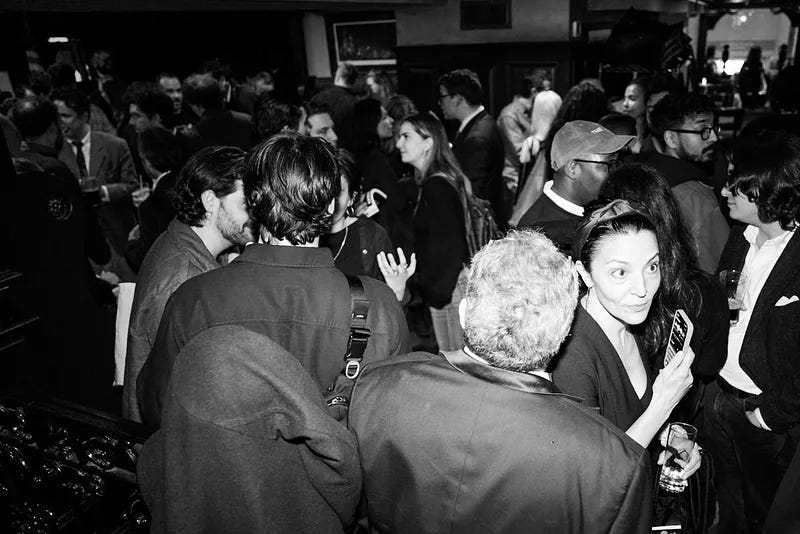
Last week, the books and culture magazine I run, The Metropolitan Review, held the launch party for its first print issue. It was a raucous time, with plenty of drinking and, thankfully, not all that much speechifying. Two hundred people packed Hurley’s, an old saloon in Midtown, and we had more enough leading lights in the crowd: reporters from the New York Times, Zohran Mamdani’s speechwriter, the Booker nominee Brandon Taylor, and Jay McInerney, the author of the legendary Bright Lights, Big City, among many others. This was night, certainly, to feel important, and I know I and the rest of the TMR team did.
But what I’ve come to enjoy most about this venture is how we’ve been able to, so far at least, avoid building any sort of ivory tower. A vast majority of the people who come to our parties and get published in TMR have no ties to any kind of literary establishment. There is nothing wrong, of course, with forging these ties, and I’ve done that myself in the last few years, but it was always important for me to curate a space where anyone who has a burning desire to read or write can feel welcome. This doesn’t mean we publish nearly everything we’re pitched—we’ve got limited slots, and there are plenty of rejections handed down—but it does mean that when I or any of the editors consider pitches, CV’s simply do not matter. As the writer Naomi Kanakia has noted, the New Yorker stopped publishing short fiction from the slush pile decades ago. There is no way into the New Yorker, as a fiction writer, without a well-connected agent. Other journals like the Paris Review are increasingly difficult to penetrate for an unknown writer. I am bothered by this state of affairs because this is how literary culture corrodes, and it flies in the face of the spirit of how these magazines operated in the last century. Once, the New Yorker cared deeply about launching new voices. The editors took pride in building careers from the ground up. And the Paris Review, at its founding, was a place for the Young Turks of literature, a home to the burgeoning counterculture. The same cannot be said today.
I do not believe in a democracy of taste, per se. One has a right to dismiss certain books or pieces of writing; all novels are not created equal. Philistinism is a scourge and a degree of literary snobbery should make a comeback. Yet I do believe anyone has a right to participate in high culture. High culture should not be limited to the Ivy League, select MFA programs, or the overly educated. Many of the New York Intellectuals, the writers and critics who defined twentieth century literary culture, were the children of immigrants who attended public schools. They matriculated at City College, the Harvard of the proletariat, with a few reaching Harvard or Columbia after humble beginnings. They were not self-taught in the classic sense, since they all had college professors, but they were hungry for literature beyond the classroom—hungry, really, to treat literature as something that is lived and breathed. They could, like Alfred Kazin—a child of the Jewish slums of Brownsville, Brooklyn—publish whole surveys of American literature before they turned thirty. They were a brilliant, ambitious, and plenty combative lot.
Having attempted, since the 2010s, something of a literary career and only found it in the last few years, I can say that I’ve enjoyed the 2020s. That might be my own bias, my own projection of personal circumstances onto a scene. It does feel, though, much more open today. I do not know if The Metropolitan Review could have found as much success a decade ago. Some of that has to do with the rise of Substack and its ability, despite its flaws, to draw many like-minded, writerly people together. We’ve got contributors from all across America and the world, and that’s what online networks can do for you. One theory I have for the little flowering happening right now—this neo-romantic culture—is that it correlates with the general decline of literary prestige and the ossification, at the very top, of the publishing world. Conglomeration has made literature seem more tired and predictable. Publicity machines do not work as well as they once did, and laurels like the National Book Award and Pulitzer Prize do not halo writers today like they might have a decade or two ago. Prestige exists, but it is more diffuse, and if it’s conferred at all, it might only find a few select writers at a given time—and even then, it’s not as if Ben Lerner is rocketing to the top of any best-seller lists. This does not mean the major publishers can’t release great literature—or don’t—or that indies have a magical ability, in the 2020s, to produce great books. What it does mean is that a person who wants to be a writer today, with very little publication credits to their name, is not as far from the mountaintop as they once were. In part, this is because the mountain is a lot smaller. But also, thanks to platforms like Substack, getting your audience—your little band of supporters—has grown much easier. You don’t need to wait a year for the Iowa Review or Kenyon Review to accept your short story submission. Writers like the aforementioned Kanakia as well as standouts like Alexander Sorondo and Henry Begler can attract more readers to their pieces than many of these journals can. That fact, even four years ago, would have seemed farfetched.
TMR can thrive because there are many talented writers in the world who’ve found the literary establishment less receptive to them than it might have been in the twentieth century, when editors at publishing houses were more empowered to cultivate new talent—to take risks—and there were fewer layers of resistance on the path to publication. There was a time when writers like Cormac McCarthy could subsist for decades without literary agents at all. There was a time when editors did read the slush, found a manuscript they liked, told their bosses, and rushed it to publication. The analog literary world, for all its problems—let’s not handwave away racism or sexism—was far nimbler than the one found today. In the fall of 1919, a 23-year-old from Minnesota could have his manuscript accepted for publication at one of the larger American houses and see it in bookstores by the spring of 1920, and he could become a sensation; this only happened because one editor, a young man named Maxwell Perkins, was permitted to gamble on a new kind of book, the campus novel—and so the world got to meet F. Scott Fitzgerald. The Metropolitan Review has no publishing house—one day!—but I’ve tried, as best I can, to at least escape the glacial pace of the contemporary world of letters. No promises, of course, since we’ve got a limited number of slots and are already booked out for many months ahead of time and small outfits have their share of stumbles. We do the best we can.
Do the parties matter? Sure. They aren’t everything, but every young magazine, I believe, should throw a lot of them. The old ones should, too. Nothing can replace the energy of a bunch of human beings in a room, sober or drunk, high or low, ideas flashing between them. There’s the fun, of course, of putting a name to a face. And there’s the bid at scene-creation, which most literary movements have made at some point. Performative, sure, but it’s not as if literature can’t be performative, or isn’t. One needn’t wait for the neo-Harold Blooms to dispense with decrees of canonization, either. One makes history by making it. Waiting around for any kind of approval, if such approval can even be said to exist anymore, makes little sense. I at least learned that over the last decade. It’s true that gatekeepers haven’t disappeared; it’s true, also, that one needn’t keep ramming up against gates again and again when there’s opportunities to build different kinds of houses, different sorts of compounds. Naturally, I am sure, The Metropolitan Review will be accused of gatekeeping; that course of events might be impossible to head off. What I do hope to do, however, is retain the publication’s openness to new talent. It’s a sad day when any magazine or publishing house willingly gives up the vanguard.
We are very New York, in one sense, but many of our top writers come from elsewhere, as do most of our editors. The name of the publication is meant to invoke a certain kind of Big City glamour, since there’s so much that’s aspirational about a city. We are not simply for the city, if we like to party there. TMR ranges all over the place, as it should. There’s a city aspect in the sense that it can be a glorious cacophony, so many different voices and ideas and arguments, forever resisting standardization. The writer needs a place where they can breathe, where they can be themselves. I’ve always bristled at house styles and it’s why TMR refuses to impose one. This used to be confusing to people, though I don’t think it is anymore. That’s the democratic spirit of magazine—we’re for taste and for talent, and we’re not going to throttle it. If we really do, I hope you’ll let us know.
And don’t forget to make yourself known on May 11. I’ll see you there.
very cool what you guys are doing
It was an excellent shindig!