

My new novel, Colossus, arrives next year. The great Dana Spiotta, a National Book Award finalist, has this to say about it: “The slick, rich, right-wing pastor Teddy Starr is a charismatic confidence man in the American vein (part Elmer Gantry, part Jay Gatsby, part Donald Trump). As fast talking as he is, as amoral as he is, Barkan gives him a fascinating, complex inner life. This thrilling novel skewers the cynicism of our current moment, but it also strikingly renders the human drama of fathers and sons, the tension between legacy and possibility.” Pre-order it now!
Summer lost its allure for me in 2023. For most of my life, I was an unrepentant beach obsessive, hungering for a roasting sun, a deepwater bob, and a light doze as the radio hissed a baseball game. I once, by myself, spent an eight-hour day in the middle of September at Coney Island, in a desperate bid to extract as much waning summer from the cooling air as possible. New York is not L.A., but it is a beach city, and every June through September I could be found on the sandy, southern stretch of Brooklyn, my flesh pinkening. It was more important to me than synagogue ever was.
My father, who lived a double-life, died on the beach. Well, not on it, per se—in a rehabilitation facility wedged next to the Rockaway boardwalk, on Beach 114th Street. Since he had gone, for so many summers, to the beach with me, particularly on weekdays when he was retired, this struck me as a bit of dark irony, like another factoid I know he would have appreciated even more: he was cremated, by absolute coincidence, in North Bergen, New Jersey, where he grew up. The ashes sit in an unceremonious cardboard box, lodged in a bedroom closet among long sleeve shirts, ballcaps, yellowing paperwork, and a cracked-screen cellphone with the last recorded voicemails from him, one about the joy of seeing an ex-Yankee second baseman, Robinson Canó, suddenly suiting up for the Braves in a game against the Mets. It’s important, for as long as I live, that I hear that voice because my father stopped talking to me four months before he died, when he was several weeks shy of his eighty-fourth birthday.
This was another savage irony, literary too, perhaps, because he was a Jewish jabberer seemingly sprung from a Philip Roth novel, an inveterate yenta on politics and sports and the city; our conversational threads were lush and always tangential, one topic, gloriously hydra-headed, perpetually birthing another. My father could be talking about Shea Stadium, the cavernous and alluringly drab old home for the Mets, and then how he, serendipitously, encountered Malcolm X there or how he less serendipitously—they occupied the same downtown Manhattan federal building—struck up several elevator conversations with Richard Nixon who, in his post-presidency, joined the tribe of Mets fanatics and would happily discuss last night’s game with anyone who might listen, including my father. Or I’d hear about the time when he was a content, if poorly-paid, high school English teacher in Hicksville, a Long Island hamlet, and had in his class a bright ninth grade student with a keen interest in rock music. They bonded, in part, because my father’s first and middle name was Joel William and the student’s full name was William Joel. Less illustriously, but no less intriguingly, my father happened to be a high school classmate of a boy named Michael Weiner who would grow up, upon moving to San Francisco, to become Michael Savage, one of the more famous and peculiar staples of right-wing talk radio. This was at Jamaica High School, in central Queens, where his family ended up after leaving North Bergen. A few years later, when my father had graduated college, he was a young aide to a long-forgotten liberal Republican congressman named Seymour Halpern. (This was, I believe, around the time my father decided to teach English.) Halpern’s district included the tony, if understated, Jamaica Estates home of a powerful local real estate developer named Fred Trump. Halpern and Fred were close, since Fred had, according to my father, gifted the congressman a low-cost (or entirely free) apartment. Fred had a rough-necked teenage son, Donald, who sometimes needed his homework done, and Halpern might have roped in a staffer or two to finish up an assignment.
Stories, stories, and they were gone, suddenly, when the hospital performed the tracheostomy to keep my father from dying. He had been, until eighty-three, relatively healthy, perhaps, I’d occasionally kid, the world’s oldest Type 1 diabetic. He was born just late enough (1939) to have access to the modern medical treatment that would prolong his life. With a smile on his face, he jammed an insulin needle into his skin throughout the day and religiously monitored his blood sugar, joking about his “dreaded disease.” And then it encroached, coming for his kidneys, and he was in and out of a hospital in Sunset Park, into a rehabilitation facility in Bensonhurst, and back at the hospital where he was intubated and, when he could talk, his voice took on the timbre of broken glass. There were only so many times, my mother and I were told, he could be intubated before he died. A tracheal tube was inserted into his neck and I would never hear him again. He communicated in short, written messages, his balky hand only able to scratch out a few sentences. This was at his last stop, in the Rockaways. He was deeply miserable there. He repeatedly tugged his tube out. He rapped his tray, or the wall nearby, with his anguished knuckles, frustrating the nurses. My mother visited every day and I did my best to make the drive from Brooklyn as much as she did. There were lighter moments, when I gave him George Santos updates or shared the baseball scores, and he could smile along for a period. But it became clear, as the summer wore on, he was deteriorating, losing interest in the voices around him, the pain in his body too great, too constricting. He stayed alive as long as he did for everyone else and died on the very last day of August.
There was another joke between us—we had many—that I would scatter his ashes in the bay in front of a Chinese buffet we frequented. Several months later, I drove out there, the cardboard box in the backseat of my Hyundai Elantra, and tried. But when I got outside, in the December chill, I couldn’t bring myself to do it. I clutched the box and began to sob.
My father, unlike me, was not a professional writer. He sought out, first, the thrill of politics and then the stability of government, but became, in his free time, a voracious reader of novels and nonfiction alike, Chekhov and the Times Metro section happily sharing a pile. He worked for many years in various federal capacities, including at the General Services Administration. He belonged, stylistically, to the midcentury, always wearing a necktie, loafers, and dress pants. He smoked a tobacco pipe—no cigarettes or marijuana for him—and brought with him a rich, weathered scent that I relished from childhood on. Despite his longtime membership in the Republican Party, he was an iconoclastic leftist would declare, without reservation, Paul Robeson was the greatest American who ever lived. He was also, in the manner of a famed fictional character from a prestige television show about Manhattan ad men in the 1960s—a show he never watched, but a show very much about the men of his generation—a person who kept secrets. My mother kept them too, but he was in his own league: I love him very dearly, still, but I wonder why he was this way. Why I never got to meet my paternal grandparents, despite the fact that they were alive for much of my childhood. Why he couldn’t tell me the truth of my birth, the truth of his marriage, the family he kept—the first family—that wasn’t my own. Why, when I was a child, he couldn’t stay the night at the apartment I grew up in, why I had to tell my friends he had a nonexistent evening job.
My partner at the time told me I should write a novel about my parents. I took her advice—they were the archetypes, and then my imagination did the rest of the work. The book was finished three years before my father died, when he could have easily read it. My father read just about everything I wrote, but he would never read this. I held off sharing the manuscript, arguing to myself this should only happen after a publisher took it on, after I knew it was going to print. Time hurried on. Selling any work of literary fiction is a slog; selling a sprawling social novel that clocks in around 145,000 words is an invitation to purgatory. The novel wasn’t just about my parents; nothing is ever so straightforward. But like many authors, I drew from my life, where the well was deeper than I had imagined. A book deal with a tiny press was closed eight months after his death.
Though my father, when he was alive, had never explicitly said this to me, I knew it to be the absolute truth: he was married to a woman who was not my mother when I was born. And he stayed married to that woman, living elsewhere, throughout my childhood and adolescence. He cleaved his life, remarkably, into two universes, and I floated in the second, doted on anyway, even as I wondered how certain facts could not possibly fit together and why, as a child, he could not be present on weekends or major holidays or, in general, at nightfall. Even, as I aged, I grew more resistant to asking open questions, to knowing the shape of my own existence.
Everything I found was through sleuthing, beginning on my mother’s desktop computer, and continuing on into college. Every discovery I made without a hint from either my mother or my father, two loving people who were otherwise loath, in almost every conceivable manner, to discuss feelings. They had the façade of a marriage, and this could make my childhood, in most instances, quite placid. I was very good at pretending, too. I was very good at imagining what I didn’t have.
And I would have to imagine whatever was churning through my father. He never really told me.
Some of this, I realize, is my fault. Whenever I’ve divulged the unusual circumstances of my life—my father having me when he was fifty, his departures each weeknight for unexplained locales—I’m often asked why I didn’t ask him or my mother about what was going on. Did I really tell my elementary school friend my father had a “night job” and leave it there? Did I not inquire at all, at least force a heart-to-heart that every half-baked bit of filmmaking or novel-writing would tell you must come somewhere three fourths of the way in? Is it a plausible that an only child with enough time on his hands did not ask direct questions? The answer, I am sorry to report, is yes. That’s the irony of growing up to be a journalist and getting paid money to ask difficult questions of strangers.
In my own life, I could ask nothing.
There was one opportunity to know more, one I never seized: in my late twenties, my father seemed to want to tell me more about his full life. By then, he was living with my mother after the death of his first wife. This was not something I was ever told directly; I learned it through public records searches and, perhaps, a stray remark. I grew up in a junior four co-op apartment in the Bay Ridge neighborhood of Brooklyn and my father had moved there, fully, in my college years, when I was away at Stony Brook University on eastern Long Island. As a family, we cohabitated together for a brief stretch until I moved out on my own, just after my twenty-fourth birthday. My father, a restless sleeper who monitored his blood sugar throughout the night, had the living room recliner as his bed, which he preferred. A transistor radio, crackling news or sports talk, always played at night, and it comforts me still to think of him there, the boy of the 1940s who grew up on radio serials and afternoon ballgames, the honeyed narratives weaving a tapestry in his mind.
He called me when I was twenty-eight. I didn’t live at home anymore but we spoke on the phone frequently and I would try to have dinner with him and my mother at least once a week. My partner once said we talked so much about politics and art and sports because we said so little about our personal lives; she noticed this long before I did. Better to discuss the Yankees lineup or the Iraq War than how my father had kept another family, with two children, in a different county. The ballplayers and politicians would be family instead. But this time, it seemed, my father wanted to talk.
I was walking on a steaming summer afternoon through the Brooklyn neighborhood of Marine Park. I was knocking on doors for votes—votes for myself, since I had made an abrupt career change and decided to run for political office. I was not so ambitious as mayoral candidate Norman Mailer. This was a mere run for state senate, and I liked to think, at the time, I had more grit Mailer ever did, since he seemed to be torn between performance art and the deadly serious desire to be a leader of men. My father liked that I was doing politics, though he would confess, once the race was done, he was glad I had lost. My reward would have been shlepping up to Albany for half the year and my writing career would’ve been sidelined; he preferred writers to politicians.
“If you ever want to talk about anything…” he told me on the phone as I was door-knocking.
It wasn’t clear what had prompted him. He was seventy-eight then, perhaps considering his mortality and what needed to be conveyed to me. After all these years, he may have been ready. We could have the phone conversation. We could sit down to dinner, later on. Air would be cleared, secrets brought to light, and I wouldn’t have to skulk around the internet for answers and he wouldn’t have to wonder about what I knew and what I didn’t.
An elegant solution, right there. I stood still on the sidewalk, the phone jammed against my sweat-streaked ear, and considered all of this.
“That’s ok.”
I did not want the conversation. I never did. I was averse to whatever wasn’t breezy, what wasn’t banter about baseball statistics or Roth novels or the fate of Congress. I dealt in facts that had little do with myself or my parents. I dealt in in-jokes. I was, when it came to my own existence, among the least openly inquisitive human beings that have come forth in the last century, if not longer. My parents’ drive for secrecy had convinced me it was best to swat away inconvenience. I could imagine, rather, nothing was wrong. And isn’t that what writers do anyway? Imagine?
The conversation didn’t progress much further. I was busy and could always duck behind business; the ants are industrious, as Thoreau once wrote, if the greater question is what are they industrious about. Rather than engage with the reality of my upbringing, I could retreat inward. I could keep wondering in private.
This is, perhaps, the greatest power of an only childhood, of having no siblings and the silence that comes with inevitable solitude. For hours on end, my mind was my only companion, and I had to find comfort in this—in this movement of my thoughts, and what universes might coalesce in static, in blankness. My father was around only several hours every weekday and my mother was often working. I was not ignored—no, I was loved very much—but there were physical limitations of this childhood that would not be overcome: the absence of the sibling playmate or sibling charge or older guide looming above, offering a portal into teenhood and beyond. It was me, and only me. I was judge and jury, prosecutor and defendant. I did not become self-reliant as much as reliant on self, and there’s a subtle distinction that I’ll parse here, as best I can. If the only child makes the self his companion, his advisor, and his confessor, he is not gaining any of the muscular self-reliance that infuses so many American myths; rather, he is deep in the lagoons of his own thoughts and moods, and there is both power and poison in this.
At least, this way, I was going to be a writer.
Why don’t you write about your parents? When my partner suggested this to me, I had just turned thirty and I was contemplating what I wanted to do next. I was known, if I was known at all, for my journalism and essays, but fiction was what had nourished me since my teenage years, and was all I ever really wanted to do. The novel, as antediluvian as it might seem in this tech-addled age, was my totem, and I considered it the highest art form—or the art form, at least, where I could channel my skill into an object that would achieve permanence. Earlier that year, I had finished a book about a murderous upstate cult, pure invention, and I was at a loss for where to go. My parents was not where I imagined I would be, not when I had established, with them at least, an unspoken arrangement: we do not discuss the personal. I, certainly, was rarely one to bear my feelings, what sticky anxieties might have lurked below. Every day was good, every arrangement fine, and passion would be reserved for the subjects that floated far beyond us, in the realms of pop culture and current events and recorded history. Even writing about my parents—and not telling them—seemed absurdly daunting, like scaling the side of a cliff in the dead of night. I didn’t even truly know what I was apprehending.
I had a few ideas. The contours of my mother’s life were easiest to know. She was, at times, a de facto single mother, and her whereabouts were always accounted for. If I were to write a novel, she would be at its center. Or, no, a character with resemblance to her would occupy that place, since I was still inventing. All I had was my inventing. This would be the fuel for my novel, Glass Century.
My mother and father met when he was an adjunct professor in the City University of New York system, in his late twenties. He was married. My mother, ten years his junior, was a college student. At some point after that, an affair began. I could have simply asked my mother and father about all of this. But there remained an unexplained psychic barrier to such probing, one that held my tongue in place. In these lacunae, at least, I could devise my own fictions.
I had gleaned I was not “planned” in any serious sense. My mother was turning forty, my father fifty, and he had not left his wife. What I’ve mulled is how comfortable my jovial, witty, and easygoing father grew with the concept of a counter-life. It’s not one he ever articulated directly, but it’s one I’ve contemplated a great deal in my writing. The act of writing creates a counter, an immediate parallel universe. Even memoir is a form of fabrication, memories leaky unless they’re eidetic, and you’re left to plumb what is essentially a form of darkness—not evil, but the absence of immediacy. My father never seemed outwardly uncomfortable with us. My mother, who did know where my father returned at night, did not seem to outwardly care either. That was my childhood, a nuclear family that wasn’t. At seven p.m., my father took off, waving at me through the window, as was his ritual. I almost thought of him then the way I might have imagined the lives of characters on television shows beyond the strictures of the episodes, these twenty-two minutes of time (eight for commercials) when life was on and Goku or Johnny Bravo could strut across the world’s stage. Every viewer implicitly invents a reality for that character that extends beyond the episode itself, that gray stretch of time not covered in the narrative—what is not real, but must be real for the show to have a logic, an architecture. Where did my father go at night? Where did he sleep? As a child, and even adolescent, I had no concept. He simply vanished into his counter-life. I was giddy that he reemerged in time to pick me up from school. I was afraid, merely, he would vanish for good.
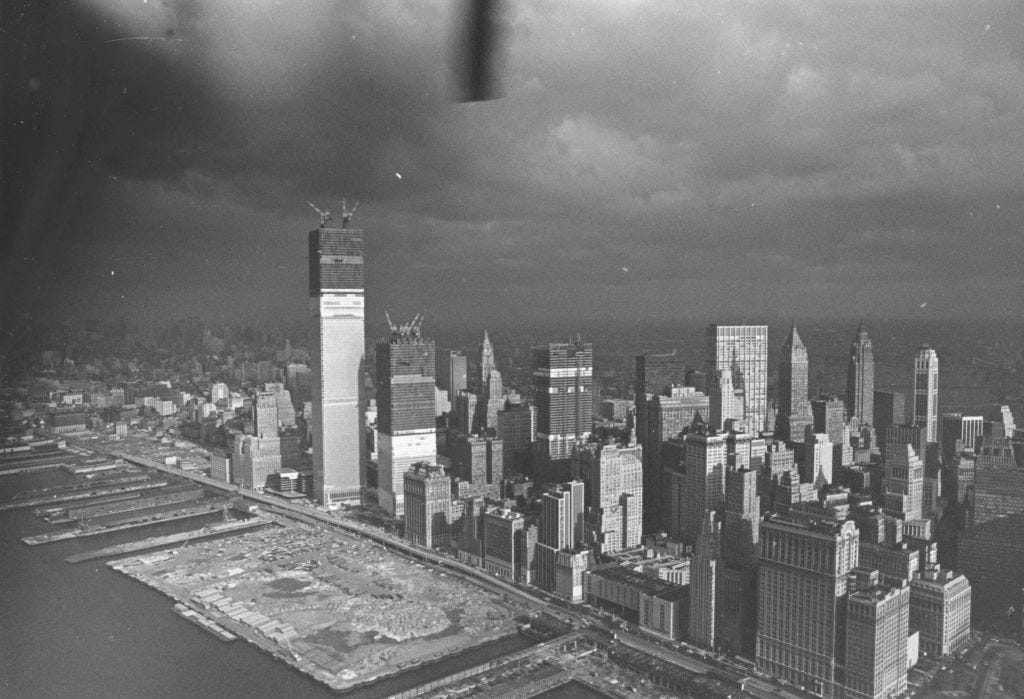
And he almost did. On a Tuesday in September, he was set to have breakfast with Neil Levin, the executive director of the Port Authority, to discuss a new job. Levin took his meetings at Windows on the World, the famed restaurant located at the top of the North Tower. My father worked in one of the small World Trade Center buildings surrounding the Twin Towers. In the days before his meeting, he was scheduled for his colonoscopy, and he very much wanted to keep his breakfast with Levin. My mother advised him to go to the doctor and meet with Levin later in the week. She thought it would be more difficult to reschedule the colonoscopy. My father didn’t agree. But he relented.
On September 11th, 2001, my father went to the doctor. He was there when the airplanes screamed into the towers and changed the century forever. Neil Levin, who was last seen at Windows on the World, died at the age of forty-six.
My father was an atheist, and didn’t subscribe to anything that had the whiff of providence or mysticism. But he did believe that life was, ultimately, a matter of luck and timing. I was eleven when my father canceled his meeting with Neil Levin and I do not know what kind of person I would have become if I lost him that day. For a generation of children, 9/11 was Graduation Day, not so much a shattering of innocence as an inauguration into the destructive potential of life on Earth. I had my father, at least, so I could only lose so much.
Writing a novel is inevitably an act of excavation. Bits and shreds of yourself fall into the product. If you are writing a novel that tugs from your life—and one, like Glass Century, that begins with characters patterned off your parents—you may reach perilous terrain. You can, if you’re not careful, end up performing a kind of ventriloquism, with your characters as dummies actualizing all of your unresolved neuroses and longings. When I began writing the novel, a few months before the onset of the pandemic, I knew there’d be two characters: Mona Plotz and Saul Glass. Eventually, as Mona became the heroine of sorts, I decided Glass was suitable for her instead, since I had an inkling I wanted that surname in the title. Mona, like my mother, became a young tennis star. Saul, like my father, became a rising government employee in a liberal Republican administration.
I want to say I didn’t interrogate my parents on their past in order to attain a certain purity in the fictional landscape. Characters, if they’re written correctly, gradually escape your grasp—you find them chattering in a way you didn’t quite fathom at the outset, and having thoughts that resemble, in time, an organic interiority. Also, more importantly, I’ve never lived inside either my parents, unless you count in utero, pre-consciousness, so however I fathomed their thoughts, it all devolved into fiction anyway. I do believe we can only know people so well, that consciousness is somewhat like a coffin to the outside world, sealing away secrets for an audience of one. But, no, really, I was afraid to ask my father about his life. Afraid, afraid. There were uncomfortable facts I dimly understood when he was alive and comprehended to a far greater to degree after he died: that I, in fact, had grandparents who were living when I was alive, despite being told, to the contrary, they were all dead. Both my father’s mother and father were living when I was born. If my grandfather had died in the early 1990s (a photograph of his headstone, which I didn’t know—until my thirties—even existed, showed a death date of 1994) my grandmother had apparently lived even longer, until 2003, when I was thirteen years-old. I never met her.
Why? My mother told me, once, that my father’s mother had figured out a secret child existed because there was a pacifier left in his car. I don’t know anything else about this anecdote—when it occurred, or what the exchange between my father and his mother was like. How much shame did my father feel? How much did these secrets burn at him? Very much, or not at all? What is it difficult to hide like that—from both his mother and his son, to manage these counter-lives? In my fiction, I attacked these questions, and also ran away from them. I had a story to tell, after all, and I was decidedly going to make up a world. My father did not meet Donald Trump, but I imagine Donald himself, as a smirking twenty-something, following Fred into a Queens meeting that Saul must take.
Fiction, fiction! I love it so. My father would have liked to have read all of this, and I lament I never showed him a draft of the novel before he died. If he was secretive, he appreciated a good show, and as a deep admirer of Roth, he could never begrudge the writers who raided their own lives. A mediative memoir and essay like this one would conventionally conclude, in some form, with the old father-son heart-to-heart, all secrets revealed, all threads tied, closure obtained. That’s not how it works with flawed people. When my father got sick, we kept talking sports and politics. In part, this was because neither of us believed he would soon be dead—or at least I didn’t. He fell, not long after turning eighty-three, and cracked the glass on an antique armoire in my mother’s apartment. (They lived together, at that point, but I call it my mother’s apartment because she was on the co-op stock certificate, not him.) By that point, he was having some trouble walking, and we thought it was good to get him to a rehab facility to build up his strength. He ended up in a dismal room in Bensonhurst, Brooklyn, not far from a clattering D train, and we bantered often about getting him out of there for Opening Day so he could watch the Mets in peace and not have to struggle with the rehab’s glitching TV or the keening of his roommate. His kidneys, though, were rapidly failing. The care at the rehab was middling, but even extraordinary attention wasn’t going to turn back the clock. He shuttled into and out of and into Brooklyn’s NYU Lutheran. He was told he probably needed dialysis, which he did not want, and we spoke for the last time on the telephone in March 2023, as I was driving back from Albany, having just had dinner with an old friend of mine, Zohran Mamdani, who was contemplating running for mayor in a few years. My father loved that kind of intrigue.
In late March, he had trouble breathing, and the hospital repeatedly intubated him to keep him alive. My mother and I considered options. At some point, a human being can’t keep getting a tube rammed down their throat, and he was going to die unless we authorized a tracheostomy. A smarmy young doctor badgered us for a fast decision, as if we were weighing whether to buy whole milk or the two percent. We decided for the surgery in April, he lived, and we hoped he could, at some point, escape the tube. A man who was once gushing with words, a wondrous motormouth of the highest order, was silenced. What misery those final months were. I don’t linger on them too much. I’ve come to take a quasi-Slaughterhouse-Five view of time, with past and future existing simultaneously on a continuum and the earlier holding as much value as the recent, so I don’t conceive of my father imprisoned in his own body, getting wheeled to immiserating dialysis at the beachside facility where he would die. I think of him, at age fifty-five or so, taking me out to the playground to dig holes in the mud. Or indulging in my toddler curiosity of fire hydrants, stooping down and unscrewing them so I could gaze inside. Some of these details made the novel, others didn’t. In the end, I couldn’t be upset about the secrets, that he withheld worlds from me and denied me the fullest conception of self. I couldn’t be upset because I loved him, and he loved me, and that, I decided, was enough. After he died, I had dreams of a shimmering intensity that I hadn’t known before and I haven’t experienced since—dreams that convinced me it was possible for the dead to commune with the living. I was grateful for having these dreams. In all of them, I told him I missed him.
goddam. that was incredible.
Inspired me to read your book.