

You’ve got time, still, to pre-order my new novel, Colossus. It’s about a pastor in the Midwest who harbors a dark secret. I had the pleasure of reading an excerpt in London recently and it went over well. Kirkus has called the novel a “canny, twisty satire of all-American posturing.” Sounds about right.
There is always danger in endings. The beast, cornered and bleeding, lashes out. Not quite enervated, still worked into a frenzy, it bites harder. What else does it know? How can it fade with dignity?
Especially when the beast, in twilight, is still powerful enough?
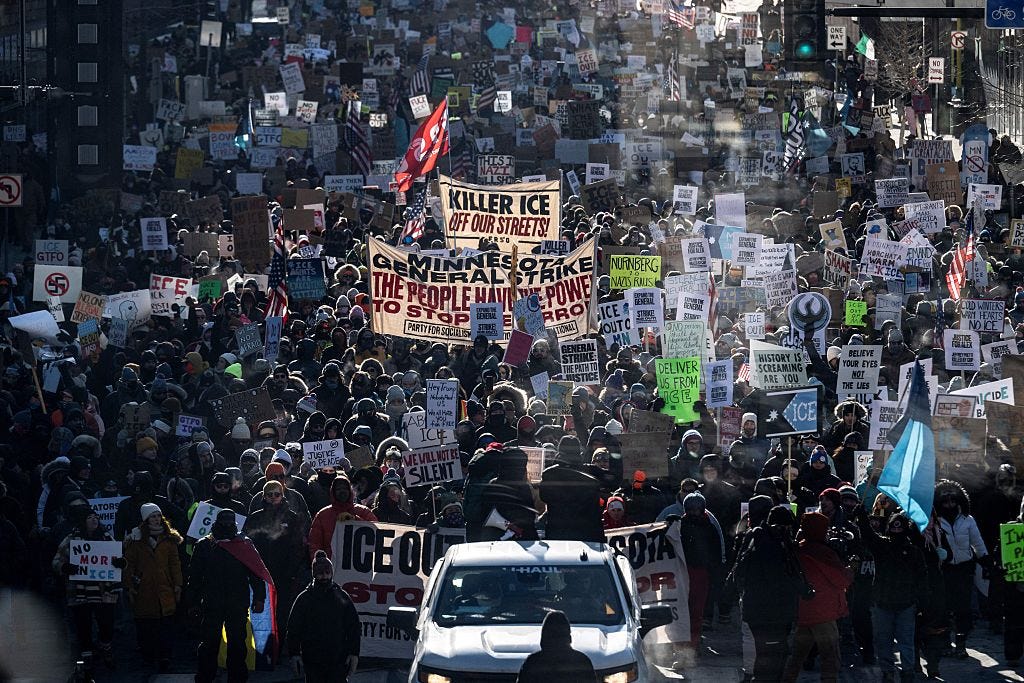
These are the contradicting realities of the MAGA movement in the year 2026. Never has it been more ascendant. Never has it been more relentlessly alienating, except perhaps in those first few days after Jan. 6, when liberals predicted the demise of Donald Trump, forgetting Richard Nixon roared back from 1960 and 1962. In less a month, ICE has killed two American civilians in Minneapolis. They are flooding and occupying a small American city for reasons that transcend any rationality. There is no great or unusual migrants surge in Minneapolis. It is not a border city, or along a drug route. It is run by left-leaning Democrats, in a state that is overseen by Democrats, but the same can be said for New York or Boston or Los Angeles. MAGA has special hate for Minneapolis, it seems, because of the Somali immigrants and a fraud scandal blamed on them. It was also ground zero for the George Floyd uprisings. The people there are suffering mightily under the mad king president, who has deputized so much governing to rank and frothing nativists like Stephen Miller and Kristi Noem, and it appears the administration is slowly learning how vastly they’ve overreached. If there was any ambiguity in the killing of Renee Good, there was none with Alex Pretti; the 37-year-old was held down and shot repeatedly. Miller and J.D. Vance, drone minds with hearts of palpable darkness, rushed to lie to the public about what they saw, but it did not work. Trump is losing in Minneapolis. As the National Guard, without much fanfare, exited cities like Los Angeles, the surge of ICE in Minneapolis will, at some point, dissipate. Tom Homan is no moderate, but his deployment there is a subtle recognition that this sort of savagery, wholly idiotic and entirely unnecessary, is not benefiting the administration at all. Trump retreated on Greenland and he will begin to retreat here. What comes next is anyone’s guess. An ICE roadshow in other cities can’t be ruled out, if a Minneapolis-level occupation has offered such diminishing returns for MAGA. Trump is, without question, deeply unpopular and his party is going to get crushed in the midterms.
When assessing the nation of my birth, I try to think, when possible, on longer time horizons. What does the United States look like in five, ten, or twenty years? What form will our republic take? I am, by disposition, neither a great optimist nor pessimist on this question, if I still believe, even in the cauldron we’re in, abject domestic decline is overestimated. Spending time in London over the last few days, I’ve come to believe the permanent damage Trump has done to the United States is in its global reputation. It will take many years—and probably more than a single successor Democratic administration—to undo the last few weeks. The Greenland threat has deeply rattled the NATO countries and Mark Carney’s speech at Davos, in which he effectively encouraged Europe to declare its independence from America, will resonate for years to come; it was, in its own way, epochal. The Europeans have spent decades as quasi-content vassals of the U.S. and that era is drawing to a close. They don’t trust the American government and they might, in turn, draw closer to China, which offers a predictable technofascism that does not directly menace them. Xi is too wise to threaten to steal away a European territory. He merely wants to sell everyone an electric car and make this the Chinese century.
The Trump era, at the close of 2028, will have spanned a full thirteen years, if one measures from descent on the golden escalator in 2015 to what would be the end of Trump’s second term or, in the event of his death, Vance’s first. Trump is, undoubtedly, a world-historical figure, and the most significant American of the twenty-first century thus far. In terms of time spent in the public consciousness—and political power wielded—he is comparable to Ronald Reagan, Richard Nixon, and Franklin Roosevelt. Nixon, Reagan, and Roosevelt all loomed, in one form or another, for a longer period of time—Nixon as a two-term vice president and comeback artist; Reagan as the governor of California who made his name cracking the skulls of the counterculture; Roosevelt through a 12-year presidency—but Trump has the advantage of thoroughly bending a major political party to his whims and obsessions, defeating the very idea of factions. Roosevelt still had to manage the southern and northern Democrats, and Reagan, as popular as he was, did not constantly purge the party of Republicans who wouldn’t declare their total fealty to him. Trump’s long-running feat has been to make MAGA and the GOP synonymous. Even now, the anti-Trump wing of his party is bleeding out on the floor. It’s plausible, if the Republicans have an especially bad midterm, opposition to Trump builds in the Republican Party, as lawmakers wake to the possibility of life after Trump. He will be, in 2028, eighty-two years old. Seizing and holding power indefinitely, at that point, will be far easier said than done.
What I’ve still struggled with is what sort of tangible domestic legacy Trump will leave behind. He might be the ultimate strong-weak executive, startingly dominant in one fashion yet fated to be more impermanent than he appears. Trump, as Ross Douthat recently argued, helped to annihilate traditional late twentieth century conservatism, best exemplified by Reagan. The wholehearted belief in internationalism and neoliberalism is gone from his Republican Party. Trump, through DOGE, has certainly pursued Reaganite goals, and in the violent capture of Maduro, there are echoes of the neoconservative right, but it is all far too disordered and dismissive of alliance-building to be regarded as anything close to a continuation of the old ways. The tariff regime, certainly, has little to do with how Republicans of the 1980s, 1990s, and 2000s thought about international trade. The question that no one can answer is what future Republican leaders—those set to preside over the party in the 2030s and 2040s—will make of the Trump period. Will they, too, believe in tariffs? Tearing up the postwar international consensus? Maybe, maybe not. A strength of Trumpism that is also its glaring vulnerability is that so much of it is tied up in one man, one cult. If Trump dies, it is hard to see where it all goes.
Consider Trump vs. FDR. Roosevelt’s death in 1945 did not lead to the crumbling of the New Deal order. In fact, the political consensus that Roosevelt forged around social spending would last another thirty years, only to be unraveled at the onset of the neoliberal era in the 1970s. The Democratic Party was an FDR party in the 1950s and 1960s, and it was Lyndon Johnson who ushered in Medicare and Medicaid, building dramatically on the New Deal. Republicans, for thirty years, governed in the shadow of Roosevelt, and neither Eisenhower nor Nixon sought to dismantle the welfare state that FDR and the Democrats erected. Many voters, no matter how socially conservative, remained Democrats for decades because they had revered Roosevelt in their youth. Roosevelt died an American icon, and remained one, with even the evils of his administration, like the internment of Japanese Americans, mostly forgotten or willfully ignored. Is MAGA going to carry on like that in a post-Trump America? What exactly gets left behind? Trump, like Reagan, sits in the right-wing pantheon, but it is harder to see Trumpian policy outlasting him. Republicans can be plenty anti-migrant but no half-sane president will ever again manage immigration like Trump, who has eschewed targeted enforcement for the catastrophe in Minneapolis and made the issue itself, once such a winner for Republicans, an actual liability. Trump did stack the courts with right-wing judges but this is as much the legacy of Mitch McConnell as Trump’s; the fall of Roe v. Wade was a collective effort, decades in the making, with McConnell and the Federalist Society laying much of the groundwork. When Trump leaves office, Americans are liable to take a much warmer view of abortion and immigration, and the most fervent Trump supporters simply don’t exist in large enough numbers to fully define a MAGA Republican Party without its patriarch. There was a brief time, following the 2024 election, when Trump could claim that he had begun to realign the nonwhite working-class behind the Republican Party. If the Democrats haven’t solved their own struggles with the working-class electorate, Trump has squandered many of the gains he made with Latinos and it’s becoming apparent, through a year of failing to tame inflation while ICE racially profiles American citizens, that Spanish-speaking voters won’t have any special loyalty to Trump’s GOP. In the next presidential election, they’ll be up for grabs.
The fascist analogy doesn’t work with Trump because fascism demands a certain coherence and discipline. America remains too large, too sprawling, for all of it to be subdued by one man, but if dictatorship and the collapse of democracy wait in the future, they will come deeper into the century or beyond, assuming a great weakening of the American economy and the withering of institutions along what was witnessed in Weimar Germany—assuming an America, ultimately, that looks very different than the one that exists today. That doesn’t mean we aren’t a damaged nation or even a sick one. It doesn’t mean that Trump isn’t still dangerous, that there isn’t more death on the horizon. ICE will continue to menace the country as long as Trump sits in the Oval Office. MAGA, diminished with each passing year, will grow desperate, and it’s in this desperation where further chaos might lie. There’s reason to believe, like 2020, the Republicans won’t go quietly if they lose in 2028. A deluded movement can keep lying to itself. Fresh right-wing mythologies are born and propagated across the internet. None of this is probably going to end very well. But it will end.
Fascism doesn’t work in America because it is too large and sprawling. But China, which is even larger, is technofascistic. Because they want to sell electric cars instead of gas guzzling freedom cars.
'The fascist analogy doesn’t work with Trump because fascism demands a certain coherence and discipline. ' - this is true for Trump specifically ('strongman' might be a better description for him) but less true for much of his inner circle and his well-known supporters, (Miller, Bannon....)