
When Biden Dies
Reckoning with the 46th president's legacy

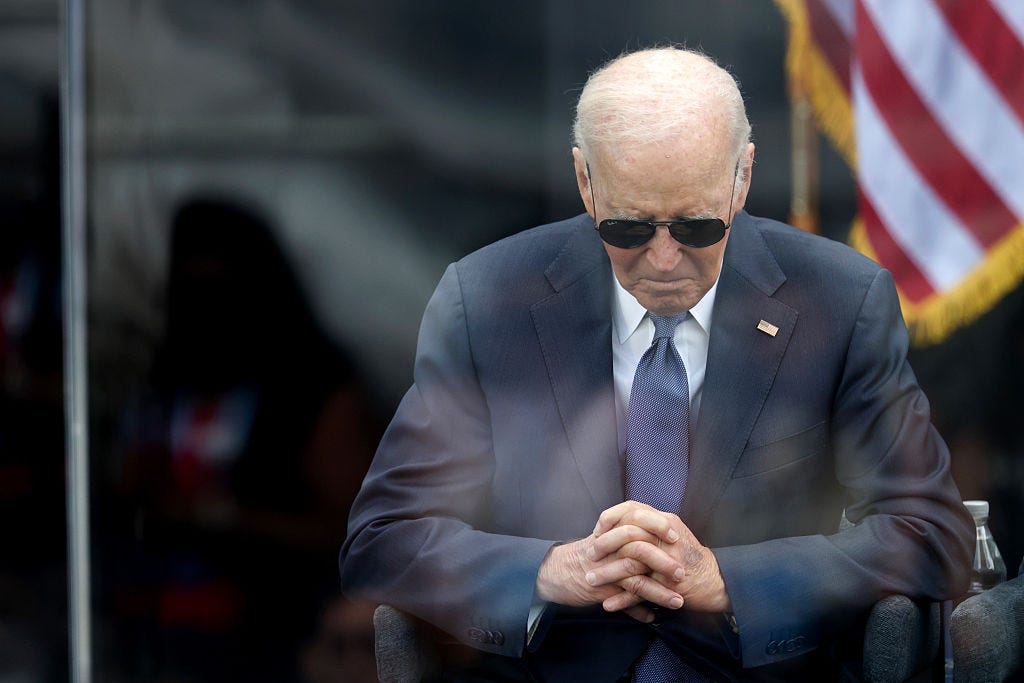
The news of Joe Biden’s ill health is a reminder of the absurd premise of his 2024 campaign—that he could be president today and serve through 2028. Biden’s disastrous decision to attempt a second term is legacy-defining. He is forever the president sandwiched between Donald Trump. When he dies, he will not be treated to the gauzy, warm-hearted retrospectives of a Jimmy Carter or even George H.W. Bush, two recent one-term presidents. Some of this will have to do with the fact that Biden, at eighty-three, is probably not going to enjoy a very long post-presidency. Both Carter and Bush got decades to rehabilitate their legacies. In different ways, both men were real failures as president, but the struggles of the twentieth century were, naturally, not as well-remembered in the twenty-first. Over time, partisan rancor fades, as do the feelings attached to particular policies. A good leftist knows Carter was, arguably, our first neoliberal president, helping to break the New Deal consensus and empower corporate America at the expense of the working-class. He had decades, though, to live as a humanitarian after he left the White House. His time out of office was of great significance.
With Biden, we all have fresh memories of 2021-2024. There was the inflation of the pandemic years, the chaos at the border, and the worst televised debate performance in American history. There was an old man, plainly senile, attempting to seek another term while freezing out a generation of younger and more capable Democrats. There was that bizarre brat summer, Biden dropping out and his vice president dropping in, and Trump’s return to power. Beyond the U.S., there were at least two major wars—Russia’s invasion of Ukraine and Israel’s immiseration of Gaza following the Oct. 7 attacks—that Biden failed to unwind, despite his half century of foreign policy experience.
That’s one capsule description of the Biden era. None of it is untrue.
Allow me, though, to offer a more generous assessment of the policy legacy—the domestic achievements in particular. Biden will eventually be remembered as the first Democratic president to break decisively from the Carter and Reagan neoliberalism—the once prevailing view, from the 1970s to the 2010s, that markets were wiser than governments, and that there should be less regulation, not more. Biden himself, as a young senator, had been a champion of this neoliberalism, which believed wholeheartedly in free trade, a shrunken welfare state and a diminished reliance on labor unions.
If Trump is the president who furiously opposed the core tenets of neoliberalism—his tariff regime and intimidation of the Fed alone are anathema to free-traders and market fundamentalists—it was Biden who brought, through his own administration, a far more withering view of corporate power. Trump talked up America First, but it was Biden who attempted, through the CHIPS and Science Act and the Inflation Reduction Act, to make that worldview a tangible reality. Trump grew popular in the Rust Belt railing against the North American Free Trade Agreement and promising a revival of domestic manufacturing. Yet in both Trump terms, there’s been no serious swerve toward a durable American industrial project. He’s cared far more about tax cuts and handouts to the wealthy. The Biden administration understood that tariffs alone weren’t enough: a federal government must invest billions in, for example, semiconductor chip factories to both employ Americans and reduce our reliance on Taiwan. So far, Trump, unlike his attacks on the green energy sector, has not been able to dismantle the semiconductor investments. The same is mostly true for the bipartisan infrastructure bill now pumping billions into neglected roadways, bridges and tunnels.
The shadow of his old boss, Barack Obama, naturally hung over Biden’s presidency. It had been Obama, in the waning days of his second term, who made it clear he preferred Hillary Clinton, not his vice president, to be his successor. But even as the two men remained personally close, President Biden, through his powerful chief of staff Ron Klain, sought to take a very different tack when it came to how the federal government approached corporate consolidations. Obama’s Federal Trade Commission approved numerous mergers between corporate behemoths and his top staffers would depart for high-level work at Uber, Amazon and Airbnb. Big Tech thrived under Obama, and monopolies proliferated. His administration didn’t bat an eye when Facebook scooped up Instagram and WhatsApp, and Google became the purveyor of the world’s most dominant search engine. While Biden, as a Delaware senator, was known as a corporate-friendly Democrat, he unleashed, as president, the most ambitious antitrust regime of the modern era. His Federal Trade Commission, led by Lina Khan, and his Justice Department’s antitrust division, overseen by Jonathan Kanter, sued Google, Amazon and Ticketmaster’s parent company, Live Nation Entertainment.
Against Google, the Biden administration was remarkably successful, winning a judgment that the tech behemoth held a monopoly in search and ads. This not the kind of work Trump can easily undo, even if he fully repudiates antitrust. Dotdash, the major publisher, sued Google for antitrust violations over its ad tech business, becoming the third major publisher to do so and the first since the Justice Department decision. With state attorneys general and private plaintiffs still bringing antitrust lawsuits, a precedent has been set, one that Trump, for all his braggadocio, has accepted. If corporate consolidation will inevitably continue, antitrust itself is back in vogue, with both political parties growing skeptical of Big Tech. Biden deserves full credit for this.
Where the Biden administration failed, relative to Obama’s eight years, was its inability to create a single memorable federal program that Americans, no matter their political persuasion, could embrace. The Affordable Care Act may be deeply flawed—the marketplace of private insurers never brought down health care costs as much as promised, especially since a public option was never introduced—but it was the first major expansion of health care in decades. Most states expanded their Medicaid rolls, and insurers could no longer discriminate against customers who had preexisting medical conditions. Once an electoral millstone around the neck of the Democratic Party, Obamacare survived furious attempts by Trump and the Republican congressional leadership to repeal it altogether. Democrats have won many elections defending its provisions. Like Medicare, Medicaid and Social Security—all derided, at one time, as socialist intrusions on a capitalist economy—Obamacare endured.
Biden spent trillions of dollars and made many significant long-term investments, but it was always difficult to explain to American voters that the money spent today would pay dividends ten or twenty years from now. Green industrial policy didn’t exactly stir the blood. Biden and congressional Democrats also made the crucial mistake of allowing a generous pandemic era childcare tax credit expire at the end of 2021. The tax credit had been expanded from $2,000 per child to $3,600 for children below the age of 6 and to $3,000 for children under age eighteen. Child poverty was measurably decreasing. It was the kind of triumph that could have been, had it been maintained, a centerpiece of Biden’s policy legacy. Now Biden, forever mashed between Trump terms, may be swallowed into the maw of history. It will take many years to properly understand where he sits in the slipstream of American time; legacies are never so fixed. Yet Biden may be remembered for being more than the nation’s oldest president, or the man who turned in one of the very worst debate performances in American history. He drove a stake through the heart of the neoliberal era.
The fact that "Biden" governed like Elizabeth Warren suggests that Joe Biden was never actually running anything
I suspect that many of the infrastructure bill's billions will vanish into consultants and studies and NGOs without nearly as much concrete improvement as was promised.