

In April, Colossus, my new novel, will appear. I encourage you to pre-order now. You won’t be disappointed.
Sometime after 2020, the literary nightlife came back to New York. It is plausible it existed in the 2010s and I simply missed it, but the more I inquire about that decade, the more I realize that whatever it was like then is very different than today. New magazines spring up like gorgeous little flowers and there are fresh reading series that are remarkably devoid of literary gatekeeping. The readers and writers aren’t famous, and may never be, and there’s a sense that the yearnings for the old markers of prestige are falling away—mostly because these markers have ceased to mean all that much. It is time, in these last days of 2025, to get a full handle on it all and describe what’s now before us.
In a recent essay, the writer Paul Franz argued in defense of the nascent neo-Romantic movement, and why it matters to think in these terms. “Romanticism rejects the triumph of the empirical; it continues to see the world in the light of desire,” Franz wrote. “Vitalism—raging against the dying of the light—is a version of that same spirit. Both assert life against death.” Of late, I’ve been thinking a great deal about vitalism. In our tech-swamped age, there’s been, among a certain number of young and middle-aged New Yorkers still interested in the written word, a rebellion. As the leader and co-founder of The Metropolitan Review, a new literary and culture magazine, I can boast of my own role, but this is a story much larger than TMR. It began in the pandemic, with the oft-derided Dimes Square which was, for all its faults and the ultimate reactionary bent of its politics, a clear attempt to break free from the 2010s screenworld and its suffocating techno-optimism. There were parties, plays, music, and readings. The reading itself, in this era, seemed to be reinvigorated, paired fully with nightlife and open to all. In the 2010s, the few literary events I brushed up against seemed to have an unseen hierarchy or arrayed around those who already carried with them a great deal of publishing credits. The Franklin Park Reading Series, based in Brooklyn and attracting the leading literary figures of that period, was emblematic of a scene that seemed far more closed off to outsiders and also, on the balance, safer. Genuine subversion was an afterthought.
In January, The Metropolitan Review will launch its own reading series and print issue, but it will be, thankfully, joining a much larger tide. It’s hard, right now, to keep track of all the new readings springing up in Brooklyn, Manhattan, and elsewhere—and this is how it should. Nick Dove, the photographer and writer, started his own earlier this year, which drew hundreds and has been packing out a new bar, the Monroe, next to the Manhattan Bridge on the Manhattan side. Dove’s reading series will merge with Danielle Chelosky’s popular “Weird Fucks” in 2026; readings about explicit sexual acts are, naturally, attracting more listeners. Mike Crumplar, the one-time Dimes Square chronicler who is now off on new adventures, recently deemed Flatbush, Brooklyn a little Laurel Canyon for writers—perhaps it is—and they’ve got their own series, Flatbush Follies, curated by Arielle Gordon and Adlan Jackson. Other series include Patio, Domino, Matthew Donovan’s Sweetychat, which began as a large Instagram chat and morphed into at least two readings, including a large Halloween bash. Beyond New York, there’s On the Rag/Casual Encountersz run by Sammy Loren and the Soho Reading Series in East London, which is the brainchild of Tom Willis. New York, London, and Los Angeles seem to be cities enjoying a cultural and literary synergy of late. I’ve begun traveling more frequently between New York and London, and find a similar, refreshing sensibility across the pond. Paris is now getting in on the action, thanks to Kyle Berlin, Samuél Lopez-Barrantes, and Augusta Sagnelli—their new Souvenir Magazine is one of the loveliest print products I’ve seen. Zona Motel, like TMR, launched on Substack and includes a mix of criticism, essays, interviews, and literary scene reports from across America.
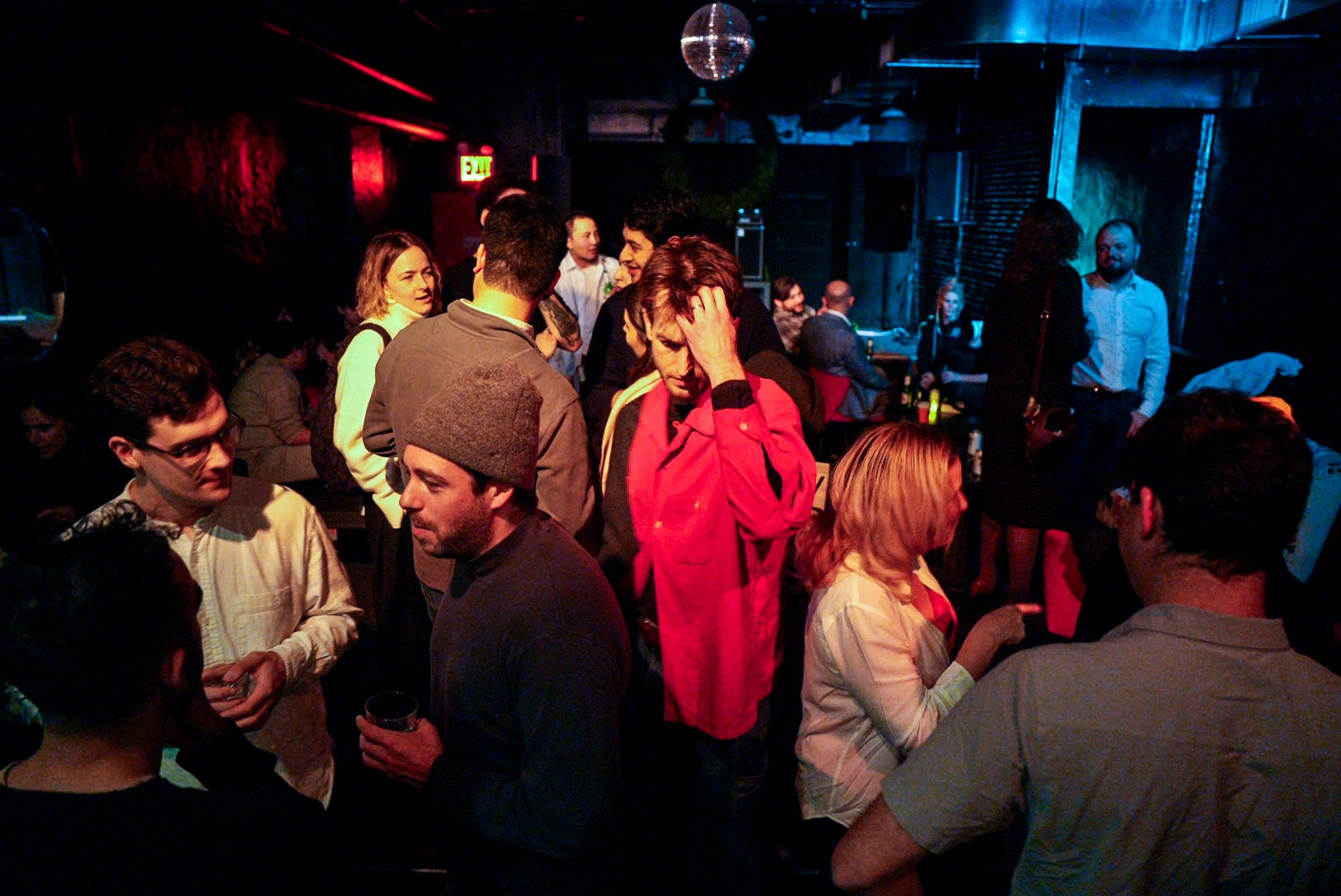
When it comes to magazines hovering around New York, there is the left professional class’ favorite, The Drift—blurbed by David Remnick, among others—which arrived in 2020 as the unstated successor to n+1, a veteran magazine still very much kicking. Many other magazines are now proliferating. There’s Whitney Mallet’s Whitney Review of New Writing, Heavy Traffic, and Civilization—all, as far as I can tell, only exist in print. Byline, something of a successor to the Dimes-era Drunken Canal, has been operating for several years. The inspiration for this piece might have been Anthony Marigold’s Non Grata, another new magazine that held its launch party at a Lower East Side art gallery earlier this month and brought together a number of the newer literary luminaries, including Adam Pearson—on a whirlwind visit from New Orleans—Chris Jesu Lee, Mo Diggs, Alex Muka, Tom Watters, James Tussing, David Polonoff, Lillian Wang Selonick, and others I am likely forgetting. There was a migration, at some point, to Crumplar’s birthday, at a bar on Flatbush Avenue. This isn’t so much about scene-reporting as a recognition that there is fresh energy, tangible verve, in the literary arts right now, and much of it is coming from below. It operates almost completely outside of Big 5 publishing or the legacy magazines. The barrier to entry, socially, is lower than it’s ever been. You simply show up. Enough of it ends up on social media, but these kinds of magazines and readings exist without the same impetus one found a decade ago to “content create.” Juicing an Instagram following is beside the point. Pretty photography can result. Beyond that, the focus is on the night itself, and the community generated.
Is the art good? Great? Posterity, and some of the critics working today, will determine that. Some magazines are better than others, as some writers are superior to others; this has been true in every single era of artistic production. Not every writer at every reading is belting out a masterpiece. Scenes, on their own, can be performative; it’s hard, truly, to conceive of a historical literary scene that wasn’t infused with some degree of artifice or self-awareness. The Modernists were self-consciously tending to their images as they made their art. We can’t know, just yet, where any of this is going. What does separate this profusion of the arts, this New Romanticism, from the artistic ventures of the 2010s is that, with a few exceptions, they are explicitly operating beyond the left-right binary. They do not exist to service the progressive movement, the Democratic Party, or, in the case of the Dimes Square publications and artistic products, MAGA and its acolytes. The old Dimes Square personalities have either faded away or reinvented themselves. Donald Trump is in the White House, so he belongs to the establishment again. Artists, even those on the right, have come to understand he is an enemy because he is against free expression. Celebrating Trump, then, is gauche. It’s about the art itself, and getting outside.
It’s easy enough to be cynical about the second aspect. Yet in the age of AI and the smartphone panopticon, the social event—the party—is its own act of rebellion. This is not about tearing down the internet or wrenching the clock back to the twentieth century. The internet is an important part of our lives, with its own realms and customs worth understanding, as Katherine Dee wrote. The internet can be a tool for creation, and the artists of all eras engage, to varying degrees, with the technologies in their wake. What matters more, though—what speaks to that Romantic vitalism—is the insistence on human supremacy. Humans can work with tech, but should never be subordinate to tech. The transhumanists will talk up AI and other technologies as a way to become, in the best way, cybernetic, and there’s enough science fiction to validate this vision. Except what we’ve actually found in the 2020s is that tech enervates: we become lazier and twitchier. We lose our ability to focus and socialize. We grow anxious and sexless. Life loses its friction, and it’s friction that builds both metaphorical and literal muscle. Why read when AI can summarize for you? Why write when AI can write for you? The neo-Romantics understand the purpose of the action is the action itself; it’s to reify the fact that we are alive, and existence is the ultimate blessing. This is not an alien concept beyond the arts. A machine defeated a human in chess decades ago, and this has not dimmed the enthusiasm for chess. Machines can move faster than man and perform far greater feats of strength, yet we are no less enamored with human athletes. Tech cannot be defeated and time, indeed, marches forward. But human beings, artists in particular, have free will. They can choose how to be. More of us, I believe, will. These magazines will keep coming. As will the parties.
I’ve never been part of the literary “parties,”partly because I get overwhelmed by the sensory stimulation and largely because I’m wary of any group, independent or institutional. I’ve probably attended less than 10 such parties during my 33 years of publishing. But I’ve also got a big name. So I’m either an insider outsider or an outsider inside.
There's also DC's Secret Ballot!